Key Derivation Process
To ensure application-layer keys, credentials, and other confidential or sensitive data can only be accessed by specific devices under defined states, Realtek Ameba series SoCs support unique binding through KDF. To prevent re-derivation of previously used keys, only trusted code can access all source data.
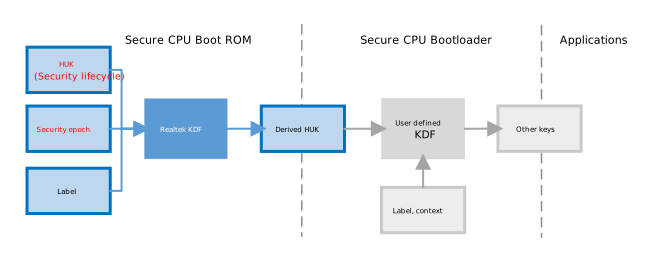
HUK derivation occurs in two phases:
Boot ROM phase (blue section on left side of diagram) implemented by Realtek.
Bootloader phase (gray section on right side) implemented by customers according to application requirements.
During Boot ROM phase key derivation, HUK is protected by the following measures against leakage:
Reading HUK in RMA state returns all
FFvalues, preventing RMA software from accessing customer-defined HUK. Effectively protects derived keys from leakage in RMA state.When customer-derived keys are compromised, data associated with these keys becomes vulnerable. Customers can update
huk_epochinmanifest.json5to re-derive new keys and migrate data using the new keys.HUK is only accessible during Secure CPU Boot ROM phase and cannot be read in subsequent phases.
All KDF inputs except HUK are known. If HUK is obtained at any stage, the entire key derivation process can be replicated, exposing all temporary keys. Therefore, HUK access must be prevented in subsequent phases.
At the end of the key derivation in the Secure CPU Boot ROM, the software writes the Sticky register bit to 1 to set the HUK to an unreadable state,
preventing subsequent stages from reading the HUK.
This Sticky bit can only be written to 1 and cannot be cleared to 0.
It is only reset when the system resets or wakes from deep sleep.
HUK OTP
Secure CPU Boot ROM determines HUK derivation enablement through the HUK_DERIV_EN bit (physical address 0x369[2]) in physical OTP.
Default state: SoC disables HUK derivation. The Sticky register bit is not written during boot, allowing immediate key readback after production programming to verify correctness.
Recommendation: After confirming successful HUK programming, write
0toHUK_DERIV_ENOTP bit.After enabling: When HUK derivation is enabled and SoC is reset, software writes the Sticky register bit during Boot ROM phase, making original HUK unreadable after Secure CPU Boot ROM exits.
Name |
OTP Address |
Size (bits) |
Description |
|---|---|---|---|
HUK |
0x310~0x31F |
128 |
Random seed written during device manufacturing, used for deriving all other keys and identifiers during the boot phase |
HUK_W_Forbidden_EN |
0x364[7] |
1 |
Once burned, HUK cannot be modified |
HUK_DERIV_EN |
0x369[2] |
1 |
HUK derivation enable |
HUK Derivation Method
Configure
huk_epochin{SDK}\component\soc\amebaxxx\project\manifest.json5:img_id: 0, img_ver_major: 1, img_ver_minor: 1, huk_epoch: 1,
Maximum length of 4 bytes for
huk_epoch. Users can updatehuk_epochto re-derive new keys as needed.Program HUK-related OTP bits:
Note
CONFIG_ATCMD_SECUREmust be enabled in menuconfig before using AT+SEC commands. Path:CONFIG SHELL → Enable ATCMD SECURE(disabled by default).Generate random seed and program:
AT+SEC=HUK_KEY,xxxxxxxxxxxxxxxxxxxxxxxxxxxxxxxx
The command automatically reads back and verifies the OTP after writing. If verification fails, an error message is returned. If HUK is correctly programmed, lock HUK write protection to prevent modification:
AT+SEC=HUK_LOCK
Enable HUK derivation:
AT+SEC=HUK_EN
Note: After enabling HUK derivation, no application software can read HUK.
Reset the device.
Obtain Boot ROM phase derived keys:
Keys derived through Realtek KDF during Boot ROM phase can only be accessed via the
DerivedKeyarray in trusted code. For security, all KDF-related data remains inaccessible to untrusted code. Users only need to declare a 16-byte external array in secure code (Secure CPU Bootloader or Image3):extern uint_8 DerivedKey[16];
Implement Bootloader phase key derivation:
Customers can implement custom KDF or use Realtek-provided
BOOT_ROM_KeyDeriveFuncto derive application keys in Secure CPU Bootloader. Use theDerivedKeyfrom previous step assecretinput. For example, one way to implement this derivation is to first combine thesecretinput with a specificlabelorcontext, and then processing the combined data with a hash algorithm (e.g., SHA2) to generate the application key. Hash algorithms provide security by not exposing thesecret.