Ameba Information Security Overview

End-to-end security architecture, safeguarding device trust across the full chain
Overview
With the rapid growth of IoT and smart devices, information security has become increasingly critical. True system security requires end-to-end consideration — from cloud services and data transmission channels to edge devices and end products — where each component must incorporate appropriate security measures. Especially for resource-constrained devices, limited processing power or cost constraints should not make them the weakest link in the system’s security chain. Ameba Trust is a security solution developed in this context to help customers integrate robust security capabilities early in the product design phase. It leverages the hardware security features of Ameba MCUs and supporting ecosystem resources to simplify the implementation of security functions and enhance the overall trustworthiness and reliability of the system.
Ameba Trust is an information security architecture designed for embedded devices, providing full-chain protection from chip boot-up to application runtime. It integrates core capabilities including secure boot, trusted execution environment (TEE), secure storage, and key management, aligns with common industry security standards, and allows flexible activation of required security features based on specific application scenarios.
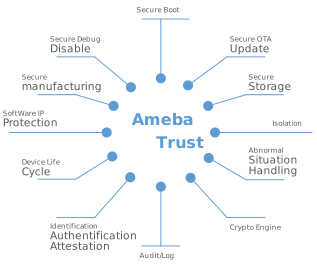
Typical security requirements include:
- Secure Boot
- Secure Firmware Update
- Code Protection
- Secure Storage
- Cryptographic Engine
- Security Isolation
- Secure Manufacturing
- Lifecycle Security
- …
Secure Boot & Secure Update
Ameba provides a reference implementation for secure boot and secure firmware update based on the Arm TrustZone® security architecture, targeting Arm Cortex-M (v8-M) processor platforms. The solution leverages the MCU's hardware security capabilities to ensure a single, immutable boot entry point and protect boot code from tampering. Key features include:
- Support for multiple cryptographic algorithms and signature schemes
- Provided signing and firmware packaging tools
- Support for single-image and dual-image update modes
- Validated through third-party security assessments (e.g., PSA Certified Level 2)

For more details, see Secure Boot and OTA Firmware Update.
Code Protection
To prevent unauthorized extraction of firmware code through debug interfaces, Ameba chips support key-based locking of debug functionality. It is recommended to restrict debug access in mass-produced devices using this mechanism, with the option to permanently disable debug interfaces for either the Secure World or Non-Secure World. Newer Ameba series further support disabling all debug access by default at power-on, and only enabling debug permissions for specific domains on-demand after successful Secure Boot verification — balancing development flexibility with runtime security.

- Password-protected access control
- Optional permanent disable of debug interface
- Authorized access enabled after secure boot

- Real-time decryption of encrypted code and data in Flash
- No software decryption required; encrypted code can execute directly
- Independent keys for multiple firmware regions
- Unique encryption key per device
When code or data is stored in internal or external Flash, Ameba chips provide transparent runtime decryption via the RSIP (Runtime Secure Image Protection) hardware module. Positioned between the bus matrix and the SPI controller, RSIP automatically decrypts data when the CPU or DMA accesses encrypted regions — without software involvement or preloading into internal RAM — enabling direct execution of encrypted code from Flash. The Flash memory can be partitioned into multiple regions, each protected by an independent key.
Firmware encryption is performed using the chip’s integrated symmetric cryptographic engine, with encrypted images written to Flash (typically via an internal RAM buffer). Keys can be uniquely generated per device and are hardware-protected, accessible only by the cryptographic engine. Note: RSIP provides transparent decryption only during read operations and does not support real-time encryption during write operations.
For more details, see Flash Decrypt On-The-Fly and SWD Protection.
Secure Storage
Sensitive data must be encrypted when stored, and the secure storage and controlled use of the encryption keys themselves are critical to overall protection. Ameba chips address different threat types through the following mechanisms:
- Protection against external attacks: Debug port access control and chip lifecycle management (e.g., locking debug permissions from development to mass production) prevent physical extraction.
- Protection against internal software attacks: Hardware isolation mechanisms (such as Arm TrustZone or secure memory regions) ensure that even if software vulnerabilities exist, sensitive data cannot be accessed by unauthorized code.
Ameba achieves secure and controlled key storage through hardware-software co-design, with the following capabilities:
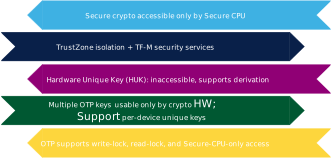
- OTP protection: By configuring security option bytes, multiple keys can be permanently locked in one-time programmable (OTP) memory — rendering them unreadable and unwritable thereafter. Certain OTP regions are accessible only from the Secure World.
- Isolated key usage: The cryptographic engine can use locked OTP keys to perform encryption and decryption, but the keys themselves are never exposed to software or external interfaces.
- Hardware Unique Key (HUK) support: Each chip has a unique HUK accessible only during the ROM boot stage, used to derive runtime keys. The HUK is hardware-locked after the ROM phase and cannot be accessed again.
- Secure state isolation for cryptographic engine: The hardware cryptographic engine distinguishes between secure and non-secure states. Application code in the Non-Secure World cannot control hardware operations in the secure state, ensuring protected key usage.
- System-level protection via TrustZone: Supports Arm TrustZone architecture to leverage hardware-enforced system isolation for key protection. It can also integrate with the Trusted Firmware-M (TF-M) software framework to provide standardized secure storage services.
Cryptographic Engine
Ameba series chips provide software support for mainstream cryptographic libraries, enabling development of applications that comply with different security standards:
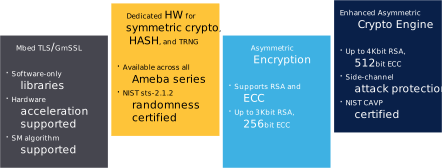
- Mbed TLS: A lightweight open-source cryptographic library supporting TLS/DTLS and widely used international algorithms. Ameba includes hardware acceleration support. Learn more in the official documentation.
- GmSSL: An open-source toolkit implementing China's commercial cryptographic standards, including SM2 (public-key encryption/signature), SM3 (hash), SM4 (block cipher), SM9 (identity-based cryptography), and ZUC. Learn more on the project website.
On the hardware side, Ameba chips integrate dedicated modules for HASH, AES, and a true random number generator (TRNG). They also include a hardware asymmetric cryptography engine capable of efficiently performing RSA (up to 3072-bit) and ECC (256-bit) operations. The RTL8721F further supports RSA (4096-bit) and ECC (512-bit), and includes countermeasures against timing attacks, simple power analysis (SPA), and differential power analysis (DPA). Its cryptographic implementations have been validated under the NIST Cryptographic Algorithm Validation Program (CAVP).
For more details, see TRNG, Symmetric Encryption, and Asymmetric Encryption.
Security Isolation
Purpose of isolation mechanisms:
- Protect the system against attacks: Isolation primarily mitigates logical attacks — especially when unpatched software vulnerabilities exist. By restricting access between different software components, critical resources remain protected even if one component is compromised.
- Enforce differentiated access rights: Isolation policies assign resources to different privilege levels. Software running in different states has distinct access permissions; for example, critical resources such as memory and peripherals are accessible only to authorized code, preventing malicious software from accessing sensitive data or performing unauthorized operations.

Isolation features in Ameba MCUs:
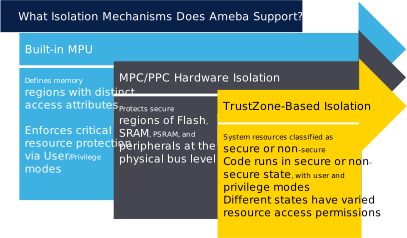
- MPU unit: All Ameba MCUs include a Memory Protection Unit (MPU) or equivalent functionality, enabling division of memory into multiple regions with configurable access attributes. Combined with the processor’s User and Privilege modes, it provides effective control over critical resources.
- TrustZone: System resources — including memory and peripherals — are classified as either secure or non-secure. Code executes in either a secure or non-secure state, with access to resources strictly governed by their security attribute.
- Hardware isolation controllers: The Memory Protection Controller (MPC) and Peripheral Protection Controller (PPC) enforce protection at the physical bus level for memory regions and peripherals marked as secure.
Through these mechanisms, Ameba MCUs not only support fundamental security functions — such as secure key storage and cryptographic operations — but also enable more advanced use cases, such as execution of authentication algorithms.
For more details, see Memory Management, TrustZone, and TrustZone Image Protection.
Secure Manufacturing
Secure Manufacturing covers every step from chip programming to device assembly, ensuring that sensitive information is not leaked or tampered with during production. Ameba provides a secure manufacturing flow that enables a unique encrypted identity for each device, allowing seamless certificate-based onboarding to major IoT cloud platforms.
In addition, to mitigate risks associated with outsourcing code or data programming to third-party factories — such as data theft, data tampering, and over-production — Ameba offers the following secure manufacturing solutions:
- Encrypted Programming: Firmware is encrypted using dedicated security tools before being programmed into Flash, ensuring that even if data is intercepted during programming, it cannot be decrypted or exploited. Unique per-device secret schemes are optionally supported.
- Unique Identity Binding: Each device is bound with unique identity information during production, which is securely stored inside the chip, guaranteeing non-counterfeit device identity throughout its lifecycle.
- Production Access Control: Ameba supports HSM (Hardware Security Module). OEMs can deliver the HSM and encrypted binary images to factories for programming. The HSM also supports programming counting and production quantity control to prevent over-production.
Through these measures, Ameba’s secure manufacturing solution not only protects sensitive information during production but also establishes a solid foundation for secure device lifecycle management.
For more details, see Technical Support
Lifecycle Security
Lifecycle Security covers the entire device journey from production, deployment, and operation to decommissioning, ensuring effective protection against security threats at every stage. Ameba provides a comprehensive lifecycle security management scheme, including the following aspects:
- Production Phase: Secures devices against tampering or malicious code injection during manufacturing via secure production processes, supporting unique identity binding and encrypted programming.
- Deployment Phase: Provides secure device registration and authentication mechanisms, ensuring only legitimate devices can connect to networks and cloud platforms.
- Operation Phase: Continuously improves device security through regular security updates and vulnerability fixes, and supports a firmware rollback mechanism to maintain stable and reliable operation.
- Repair Phase: Implements a secure device repair process, ensuring that neither chip vendors nor authorized service partners can access user-sensitive data during repair.
- Decommissioning Phase: Provides a secure device decommissioning process to prevent devices from being maliciously reused after retirement.
With these safeguards, Ameba’s lifecycle security solution protects devices across all stages, delivers comprehensive security for customers, and helps them address evolving security threats.
For more details, see Lifecycle Security
Security Certifications
Ameba MCUs and corresponding solutions have achieved multiple globally recognized security certifications and regulatory compliances, fully meeting the security requirements of IoT devices. Details are as follows:
PSA Level 1 Security Certification
- RTL8730E Series Certified to PSA Level 1
- RTL8720E Series Certified to PSA Level 1
- RTL8726E Series Certified to PSA Level 1
PSA Level 2 Security Certification
PSA API Compliance Certification
For more details, View additional security certifications and regulatory compliance details at Security Certification and Standards for IoT Chips
Development Resources
| Icon | Resource Name | Link |
|---|---|---|
 |
SDK Download | Link |
 |
FreeRTOS Security Guide | Link |
 |
Contact Us | Link |
Recommended ICs
| Features | Filter | RTL8720F | RTL8721F | RTL8721Dx | RTL8720E | RTL8710E | RTL8726E | RTL8713E | RTL8730E | RTL872xD | RTL8735B |
|---|---|---|---|---|---|---|---|---|---|---|---|
| AES Hardware Engine | Y | Y | Y | Y | Y | Y | Y | Y | Y | Y | |
| SHA Hardware Engine | Y | Y | Y | Y | Y | Y | Y | Y | Y | Y | |
| ECDSA/ECDH Hardware Engine | Y | Y | N | Y | Y | Y | Y | Y | N | Y | |
| EDDSA Hardware Engine | Y | Y | N | N | N | N | N | Y | N | Y | |
| RSA Hardware Engine | Y | Y | N | N | N | N | N | Y | N | Y | |
| Secure Boot | Y | Y | Y | Y | Y | Y | Y | Y | Y | Y | |
| Flash OTF Decryption | Y | Y | Y | Y | Y | Y | Y | Y | Y | Y | |
| Arm TrustZone | Y | Y | Y | Y | N | Y | N | Y | Y | Y | |
| OTP Secure Storage | Y | Y | Y | Y | Y | Y | Y | Y | Y | Y | |
| True Random Number Generator | Y | Y | Y | Y | Y | Y | Y | Y | N | Y | |
| HUK Derivation Mechanism | Y | Y | Y | Y | Y | Y | Y | Y | N | Y | |
| Authenticated Debug Access | Y | Y | Y | Y | Y | Y | Y | Y | Y | Y |