Ameba Smart Home Solutions

Building the foundation for a boundless, intelligently connected, and secure future home
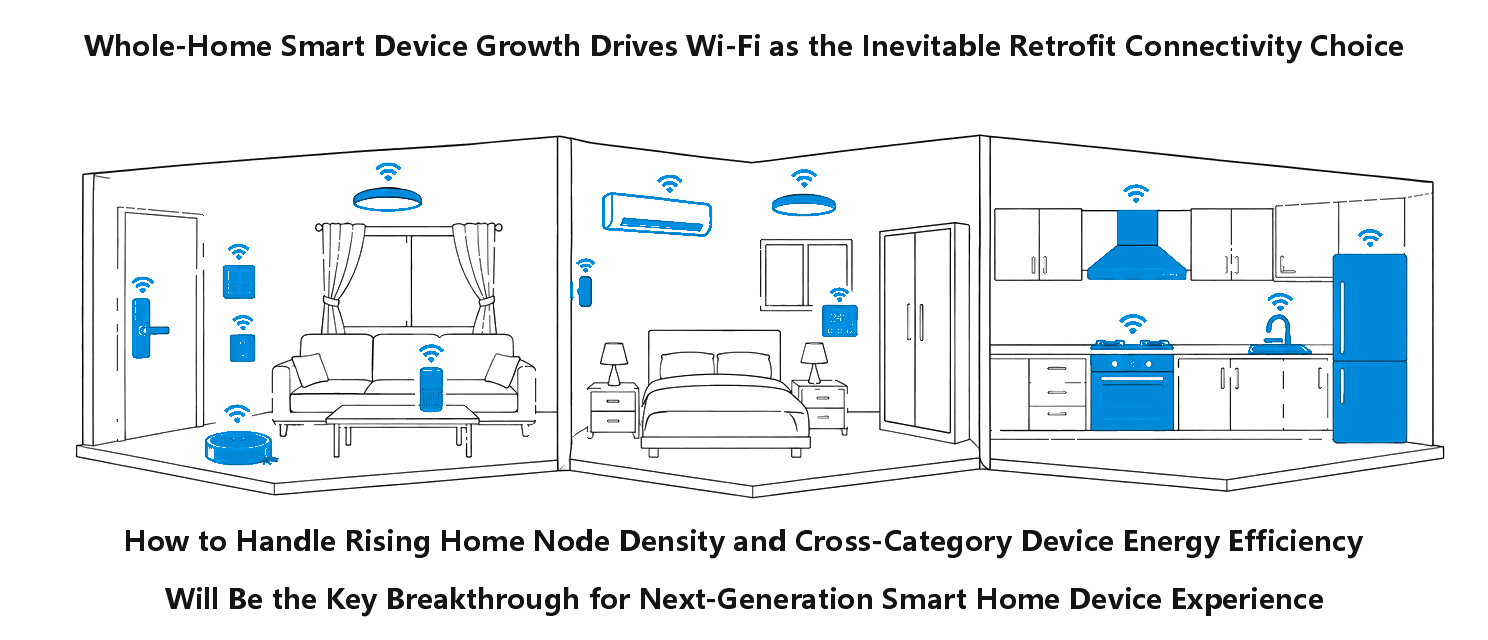
As whole-home smart deployments push toward ultra-high node density, the engineering challenge for end devices has shifted from basic "connectivity availability" to a multi-dimensional balancing act among "high-concurrency congestion, micro-amp-level energy efficiency, and protocol-stack compute overhead." Facing a complex home 2.4GHz RF environment and the heavy system load introduced by new standards such as Matter, developers need to strike a rigorous balance between communication throughput, power budget, and BOM cost.
Realtek Ameba's smart home solution is the ideal choice for tackling this engineering challenge. Backed by a highly integrated multi-mode SoC and a comprehensive component-based SDK, Ameba fully encapsulates complex low-level communication, power scheduling, and ecosystem protocols. It frees terminal manufacturers from tedious system-level integration, enabling efficient delivery of reliable smart devices within strict cost budgets. The solution has been adopted by numerous leading home appliance and lighting brands worldwide and has achieved mass production at scale in their flagship product lines.
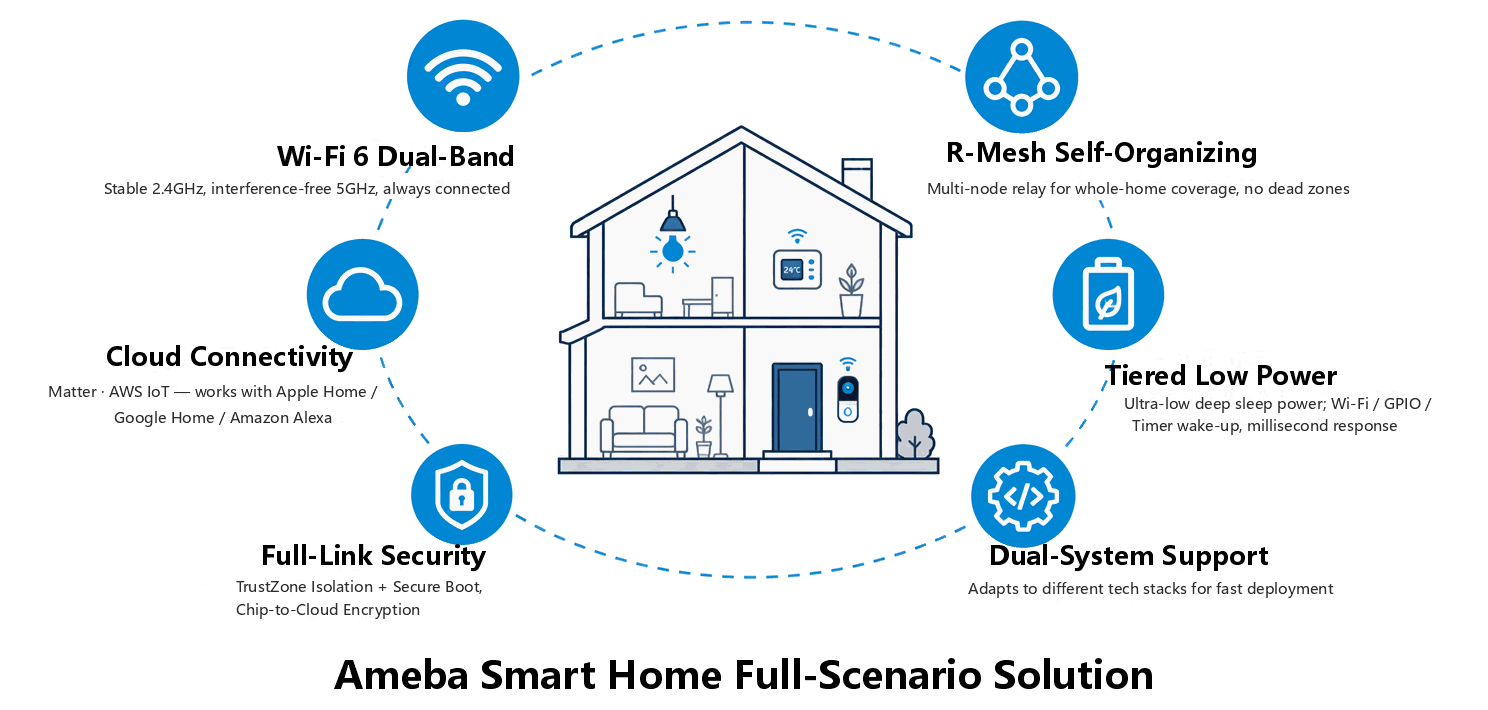
The Ameba solution is dedicated to building a solid technical foundation for modern smart home applications. Focusing on the most challenging engineering nodes in device development, the platform provides developers with key technical mechanisms and capability support.

01 · High-Concurrency, Interference-Resistant Networking
Smart home devices typically operate in the extremely congested 2.4GHz band, where strong RF interference (e.g., microwave ovens) or massive concurrent nodes can easily cause delayed control commands or device disconnection. Ameba has undertaken multi-dimensional innovation at the communication technology level:
- High-Density Concurrency and Intelligent Dual-Band: Fully adopts the Wi-Fi 6 (802.11ax) standard. Leveraging OFDMA (Orthogonal Frequency Division Multiple Access) and MU-MIMO technologies to finely partition wireless channel resources, fundamentally eliminating node congestion when massive devices connect concurrently. It also supports intelligent switching between 2.4GHz and 5GHz dual bands, balancing long-range stable connections with low-interference, high-bandwidth communication needs.
- Self-Healing Mesh and Whole-Home Coverage: Equipped with Realtek's proprietary R-Mesh technology, network signals extend smoothly through intelligent collaboration among multi-level nodes, breaking through the coverage limits of single-point routers and letting whole-home smart devices leave signal-dead-zone "disconnection" issues behind for good. Learn More

02 · Tiered Sleep, Low Power Consumption
How can smart home devices balance "always online" with "long-lasting battery life"? Ameba breaks through the traditional trade-off between real-time responsiveness and power consumption, building an extremely low-power engine at the chip level:
- Micro-Amp-Level Tiered Sleep: By optimizing baseband wake-up logic, average power consumption is strictly controlled under 100μA while maintaining cloud Wi-Fi keep-alive; during idle deep sleep, the system cuts non-essential power supply, driving consumption down to as low as 12μA.
- Millisecond-Level Rapid Wake-Up: Supports GPIO wake-up, timer wake-up, and Wi-Fi cloud wake-up (WoWLAN). Devices "sleep deep, wake fast," achieving millisecond-level response while significantly reducing terminal maintenance costs.

03 · Full Ecosystem Protocol Stack
Facing the pain points of smart home platform fragmentation and high overseas adaptation costs, Ameba's underlying native architecture helps enterprises achieve "develop once, access every ecosystem":
- Supports the Matter universal standard protocol, giving products built-in interoperability out of the box, seamlessly connecting to Apple, Google, Amazon, and other major global smart ecosystems.
- Based on mature FreeRTOS and Zephyr systems, integrating HTTP, MQTT, CoAP, WebSocket, and other protocols, with deep AWS IoT compatibility, enabling developers to achieve full-scenario deployment with an extremely high code reuse rate.

04 · CSI Environmental Sensing
Traditional environmental sensing relies heavily on optical or infrared sensors—the former carries non-negligible privacy risks for the home, while the latter faces technical blind spots from physical obstruction. Going beyond pure data communication, Ameba innovatively introduces high-precision Wi-Fi CSI (Channel State Information) technology, transforming Wi-Fi into an "invisible whole-home radar":
- Through-Wall Sensing: Powerful non-line-of-sight penetration effortlessly crosses walls to achieve high-precision human presence detection.
- Zero Privacy Risk: Based on pure RF signal analysis with zero image capture, physically eliminating camera-related privacy leakage risks.

05 · Hardware-Level Security Isolation
As devices move fully to the cloud, software-only encryption alone struggles to defend against data hijacking risks and fails to meet modern commercial compliance reviews.
Ameba chips build in TrustZone hardware physical isolation and Secure Boot startup verification, constructing an impenetrable low-level security sandbox. Combined with the latest WPA3 encryption at the wireless layer and TLS/SSL mutual data authentication, it establishes an encrypted communication channel for sensitive device-to-cloud interactions that meets international commercial standards.
System Architecture
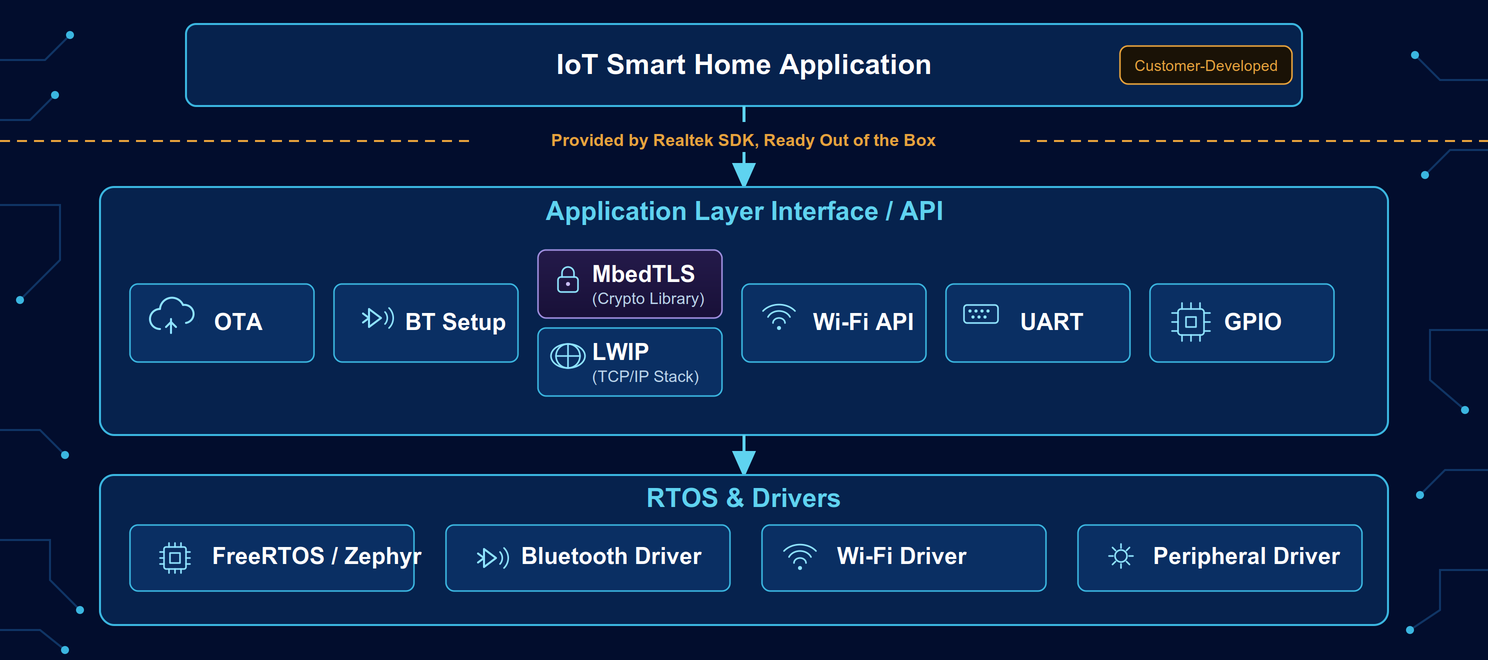
The Ameba SDK uses a clean layered architecture that packages low-level capabilities—RTOS, drivers, and the MbedTLS crypto library—ready to use out of the box, and exposes them through standardized application-layer interfaces (OTA, Bluetooth provisioning, LWIP, Wi-Fi API, UART, GPIO, etc.). Developers can focus on building smart home applications directly on top of these interfaces without worrying about low-level implementation details, significantly shortening the product development cycle.
Use Cases Validated at Scale
Backed by a highly integrated SoC architecture and rich industrial-grade peripherals (UART, SPI, ADC, PWM, etc.), the Ameba solution greatly simplifies peripheral hardware design and has achieved mass production at scale across numerous leading global brands.
Smart Major Appliance Hub
In the white goods sector, the Ameba solution has become the trusted choice of numerous leading global brands
Typical applications: smart air conditioners, refrigerators, washing machines, microwave ovens, and other major appliances
Smart Lighting Matrix
Perfectly compatible with mainstream IoT cloud ecosystems, building a lossless, self-healing lighting network
Typical applications: smart lights, smart plugs, wall switches, and other whole-home lighting scenarios
Development Resources
| Icon | Resource Name | Link |
|---|---|---|
 |
FreeRTOS SDK Download | View |
|
Zephyr SDK Download | View |
 |
Matter SDK | View |
|
AWS SDK | View |
 |
Wi-Fi Development Guide | View |
|
Wi-Fi R-Mesh Development Guide | View |
|
Peripheral Programming Guide | View |
|
OTA Upgrade Programming Guide | View |
|
Network Protocol Examples | View |
 |
Contact Us | View |
Recommended ICs
| Features | Filter | RTL8720F | RTL8721F | RTL8721Dx | RTL8720E | RTL8710E | RTL8726E | RTL8713E | RTL8730E | RTL872xD | RTL8735B |
|---|---|---|---|---|---|---|---|---|---|---|---|
| Application Processor |
Cortex-M | Cortex-M | Cortex-M | Cortex-M | Cortex-M | Cortex-M | Cortex-M | Cortex-A | Cortex-M | Cortex-M | |
| DSP | N | N | N | N | N | Y | Y | N | N | N | |
| ISP | N | N | N | N | N | N | N | N | N | Y | |
| Arm TrustZone | Y | Y | Y | Y | N | Y | N | Y | Y | Y | |
| Dual Band | N | Y | Y | N | N | N | N | Y | Y | Y | |
| Wi-Fi 6 | Y | Y | N | Y | Y | Y | Y | Y | N | N | |
| R-MESH | Y | Y | Y | N | N | N | N | N | N | N | |
| Ultra-low Power | Y | Y | Y | N | N | N | N | N | Y | Y | |
| Ethernet | N | Y | N | N | N | N | N | N | N | N | |
| BT Dual Mode | N | N | N | N | N | Y | Y | Y | N | N | |
| HMI | N | Y | Y | Y | N | Y | Y | Y | N | N | |
| Audio ADC | N | N | N | N | N | Y | Y | Y | Y | Y | |
| Audio DAC | N | N | N | N | N | Y | Y | Y | Y | Y | |
| SDIO Host | N | Y | N | N | N | N | N | N | N | N | |
| SD/EMMC Host | N | Y | N | N | N | N | N | Y | Y | Y | |
| USB | N | Y | Y | N | N | N | N | Y | Y | Y | |
|
BT Dedicated Antenna |
N | N | N | N | N | N | N | Y | N | N | |
| CAN | N | Y | N | N | N | N | N | N | N | N |