Ameba Linux Solutions

An open, full-stack Linux ecosystem that accelerates smart device development
Overview
Voice interaction, on-device intelligence, display-equipped devices, and multi-protocol collaboration have become essential requirements for smart IoT products. IoT endpoints are rapidly evolving from simple connected devices into intelligent nodes capable of local computing, networking, and interaction. Linux remains the operating system of choice for embedded devices and IoT applications worldwide, continuously empowering industries through its unmatched maturity, rich open-source ecosystem, and strong community support.
The Ameba Linux solution targets IoT products that require local computing, reliable connectivity, and a broad software ecosystem. It delivers complete support spanning the silicon platform, system software, application frameworks, and development resources, reducing integration complexity and accelerating time to market.
Architecture
The Ameba Linux solution uses a layered design that organizes hardware resources, operating system capabilities, common software services, and customer applications into a single software stack. The Linux SDK spans this stack, handling hardware adaptation below and exposing standard interfaces for application development above.
This architecture decouples hardware and software while substantially improving development efficiency. Hardware changes or kernel upgrades leave upper-layer APIs unchanged, so applications need no modification. Developers do not need to understand register configuration or timing tuning—standard API calls are sufficient to build applications.
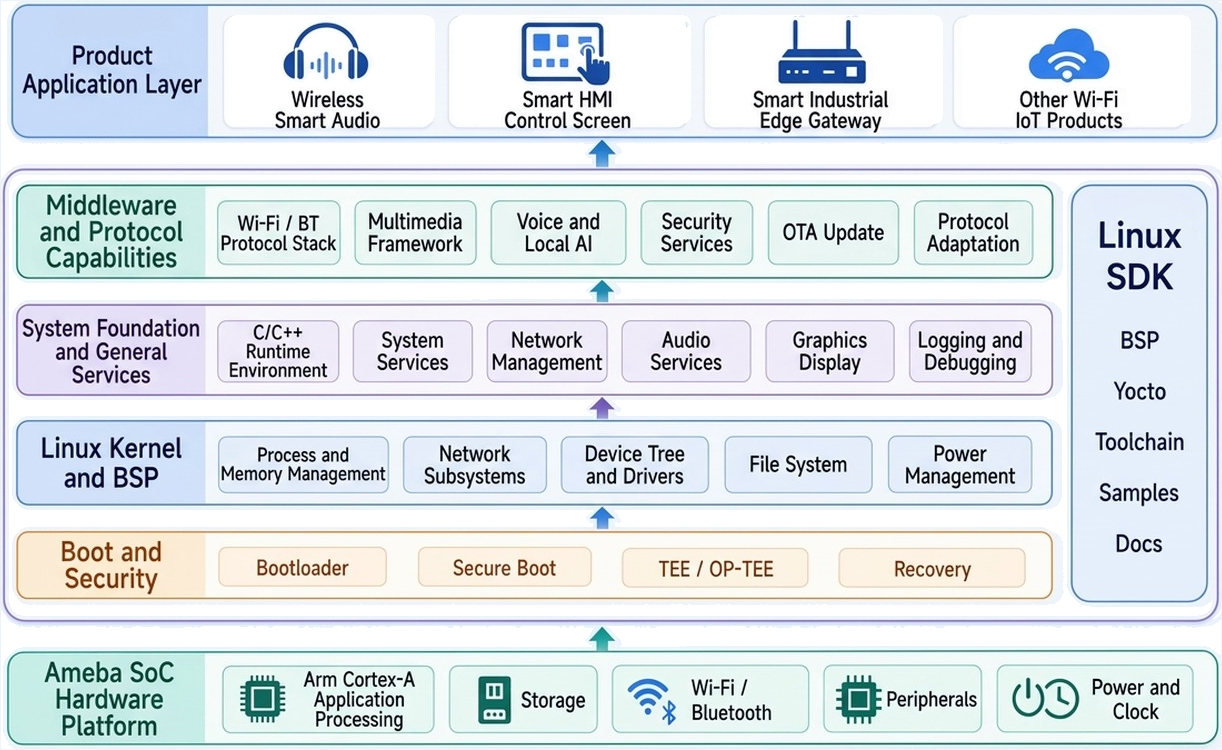
The Ameba Linux solution helps developers reuse the standard Linux ecosystem and reduce low-level adaptation effort. We deliver more than a chip—we deliver end-to-end capability from the hardware foundation through system software to application development, covering the full path from prototyping to volume production.
Software Capabilities: Full-Stack Linux SDK
The Linux SDK for the Ameba SoC platform is built on the Linux kernel and BSP. It uses Yocto to tailor the system to product requirements, extend software packages, and build target firmware, covering the full flow from chip boot and system adaptation to firmware generation. Toolchain, debugging, flashing, and runtime validation run throughout, supporting configuration, image generation, development validation, and application deployment.
System Foundation and Build Capabilities
As the software foundation of the Linux SDK, the Linux kernel and the Yocto build system together enable reproducible builds. The SDK centrally manages source code, build configuration, dependencies, and toolchain versions, ensuring identical inputs yield verifiably consistent firmware across development, continuous integration, and volume production.

Linux Kernel and BSP
- Boot chain: Integrates Linux Kernel 6.18 LTS, boot components, device tree, boot parameters, and RootFS
- Platform adaptation: Covers processor, MMU, memory, storage, network, and board-level peripheral initialization
- Driver support: Provides Linux driver frameworks for wireless, USB, display, audio, and general peripherals
- Runtime environment: Organizes RootFS, user space, system services, Shell, and basic network tools

Yocto Project Build System
- Software organization: Manages system components and dependencies through Layer, Recipe, Machine, and Distribution
- System customization: Supports kernel configuration, RootFS trimming, package selection, and customer application integration
- Image building: Generates kernel, RootFS, device tree, and target firmware images in a unified flow
- Build management: Supports toolchain generation, cache reuse, log analysis, and reproducible builds
Network Connectivity and the Standard Wireless Ecosystem
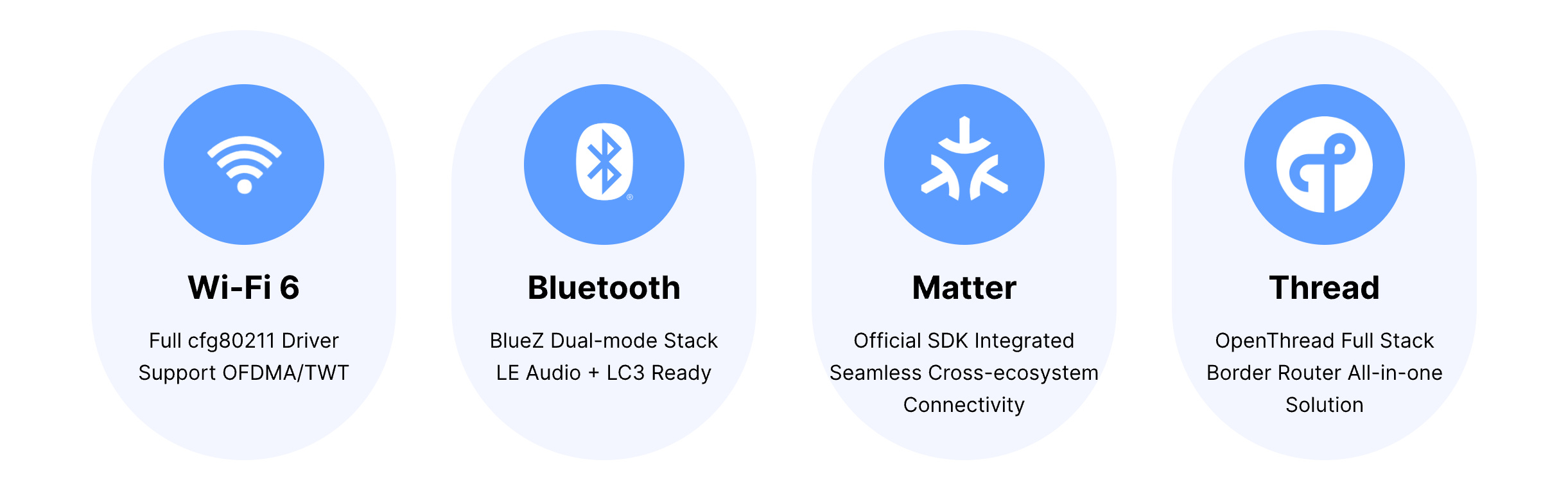
Wireless connectivity is a core part of the Ameba Linux software stack. Building on the standard Linux wireless framework, the Linux SDK provides drivers, protocol stacks, connection management, and application interfaces, presenting the complete software path from underlying radio resources to connected applications.

Mature Wi-Fi Subsystem
- Wi-Fi 6 and standard drivers: Integrates the Linux kernel cfg80211 framework, delivering a standardized connectivity path from radio and driver through firmware to network applications
- Peer-to-peer and proximity discovery: Supports Wi-Fi Direct (P2P) and Wi-Fi Aware for fast onboarding, neighbor discovery, and peer-to-peer data transfer
- Network management and application interfaces: Uses ConnMan, WPA Supplicant, and related components for scanning, connection, authentication, IP configuration, and state maintenance; applications access network capabilities through standard sockets, network interfaces, and user-space tools, reducing coupling to the chip implementation

Bluetooth and Next-Generation IoT Protocols
- Dual-mode Bluetooth with BlueZ: Integrates the standard Linux BlueZ stack with support for Classic Bluetooth and Bluetooth Low Energy (BLE), providing a unified software foundation for audio, peripheral connectivity, and low-power devices, with extensibility for LE Audio, LC3, and other next-generation audio capabilities
- Smart home protocols: Integrates Matter, OpenThread, and other IoT protocols, enabling devices to join mainstream smart home and low-power network ecosystems
- Protocol and application extensions: Integrates network services, IoT protocols, and third-party components as required, reusing mature Linux community debugging tools and application frameworks
Graphics, Multimedia, and Intelligent Interaction
Beyond the Linux system foundation and wireless connectivity, the Linux SDK extends graphics, audio, multimedia, voice, and edge intelligence capabilities as product requirements demand. Customer applications, open-source packages, and product-specific services can be added to user space and brought into a unified build flow through Yocto recipes and distribution configuration.

Standard Graphics and Multimedia Frameworks
Delivers complete software capability from graphics display and UI interaction to audio/video playback and processing, fully leveraging the compute, display, and multimedia performance of the chip.
- Graphics display: Based on DRM/KMS drivers and lightweight graphics libraries such as LVGL, supporting applications from basic interfaces to complex interactive animation
- Audio processing: Integrates audio drivers, codecs, DMA data paths, and audio services such as PipeWire or PulseAudio, supporting playback, capture, mixing, routing, and real-time processing of multiple audio streams
- Multimedia processing: Supports GStreamer and FFmpeg, covering audio/video playback, streaming transport, and real-time processing

On-Device Voice and AI Extensions
Deeply integrates the in-house AIVoice offline AI solution, providing a complete, reliable, and flexible foundation for local voice processing.
- Audio front end (AFE): Integrates echo cancellation, beamforming, and noise suppression to capture voice commands clearly even in complex acoustic environments
- Keyword spotting (KWS): Accurately detects preset wake words for low-power, high-accuracy always-on readiness
- Voice activity detection (VAD): Intelligently determines the start and end of speech, filtering out silence and ambient noise
- Offline speech recognition (ASR): Performs command-word recognition and understanding locally for instant response with no network dependency
Note: Graphics, multimedia, voice, AI, and other components are not enabled by default on every chip model or SDK configuration. Evaluate code and resource footprint against the target memory configuration and integrate them as needed.
Hardware Foundation: Ameba SoC Platform
The Ameba Linux solution is built on a single Ameba SoC platform (RTL8730E) that integrates heterogeneous cores on one die. Physical division of labor and hardware-level coordination across cores balance high performance, real-time responsiveness, and low power.
Single-Chip Heterogeneous Multi-Core
- Arm Cortex-A32 application core: Dual-core at 1.2 GHz with a hardware MMU, supporting Linux virtual memory and address isolation for complex applications, HMI, on-device AI, and multimedia
- Arm Cortex-M network core: Handles wireless protocols and real-time tasks independently, physically isolated from the application core to keep main-core applications stable
- Independent low-power core: Targets low-power scenarios, processing sensor data and managing device state while the main core sleeps to sustain ultra-low-power standby
- Multi-core coordination: Inter-core communication and task partitioning run applications, wireless protocols, and low-power tasks together, balancing performance, real-time responsiveness, and power
Wireless Connectivity Foundation
- Dual-band Wi-Fi 6: 2.4 GHz and 5 GHz with 802.11 a/b/g/n/ac/ax support, suited to HD video streaming and low-latency scenarios
- Dual-mode Bluetooth: Supports Classic Bluetooth and BLE with LE Audio, Auracast, and LE 2Mbps / Long Range for improved audio quality and connection stability
- Radio and coexistence design: Wi-Fi and Bluetooth use independent radio paths and antennas to reduce mutual interference, enabling high-speed Wi-Fi and Bluetooth audio to run concurrently
- Regulatory certification: Wi-Fi Alliance and Bluetooth SIG BQB certified for global compatibility and commercial deployment

Rich Peripheral Interfaces
- Display: MIPI-DSI, RGB, and QSPI interfaces for LCD and touch panels
- Audio: I2S, PDM, and multiple digital/analog microphone inputs with a built-in audio codec
- Storage expansion: USB 2.0 Host/Device and SDIO Host for SD cards, external storage, cameras, and HID devices
- General control: GPIO, UART, SPI, I2C, PWM, ADC, and infrared transceiver for connecting sensors and control devices
- Debug and flashing: SWD debugging, UART/USB flashing, and certified debugging across the full development-to-production path
Note: The RTL8730E family offers a broad part-number matrix. All memory configurations reuse the same core architecture, covering a range of PSRAM and DDR memory options.
Security: Full-Chain Defense in Depth
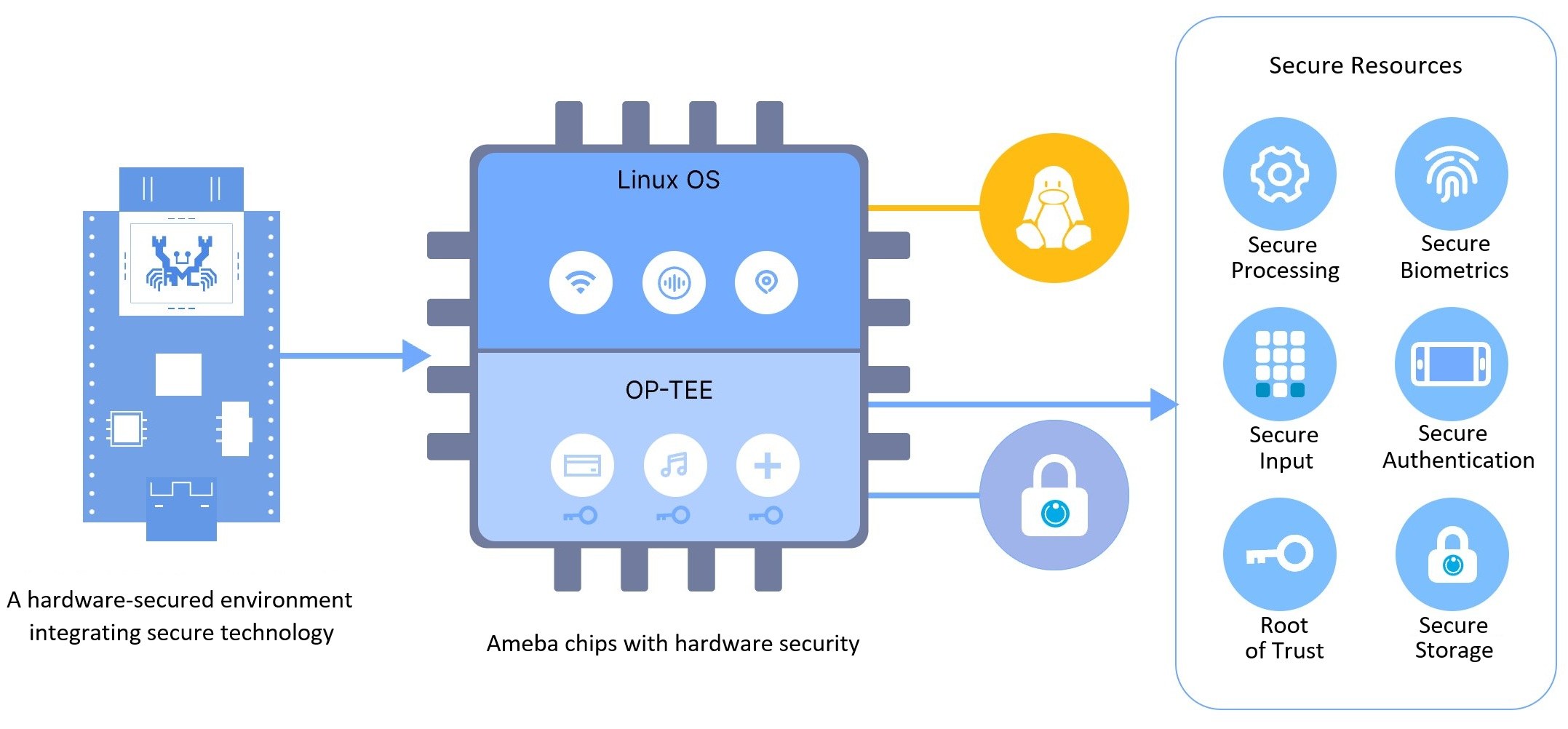
The Ameba Linux solution is not a single-layer safeguard; it establishes a chain of trust spanning the entire device lifecycle. By combining chip security mechanisms, boot-chain verification, and system software capabilities, it delivers full-chain protection across device boot, firmware execution, key protection, and system updates, keeping IoT devices resilient against network attacks.
- Hardware root of trust: Security keys, device IDs, and other sensitive data are provisioned inside the chip as the starting point of the trust chain, with hardware mechanisms preventing tampering with critical data.
- Secure boot: On power-up, U-Boot, the Linux kernel, and the root file system are verified in stages, ensuring the device only runs authorized system software from the earliest boot stage.
- Trusted execution environment: Built on Arm TrustZone® hardware isolation, the Linux execution environment and the TEE are isolated from each other. Even if the Linux domain is compromised, core security services, keys, and sensitive data remain hardware-protected by the trusted environment.
- Hardware crypto engine: Integrates public-key cryptography (RSA, ECDSA, EdDSA) and symmetric encryption and hash algorithms (AES/SHA) to provide hardware support for authentication, data protection, and secure communication.
- Security maintenance and updates: Combines image verification, version management, failure recovery, and OTA mechanisms to reduce the risk of tampering and boot failure during firmware updates, keeping the trust chain effective over the device lifetime.
Memory Options: Flexible DDR and PSRAM
Built on the same Ameba SoC platform (RTL8730E) and a unified Linux software framework, the Ameba Linux solution offers memory configurations ranging from lightweight PSRAM to high-capacity DDR, covering resource-constrained devices, connected endpoints, and high-performance IoT products.
- DDR option: Targets products requiring larger memory capacity, higher bandwidth, and more complex software combinations. It supports a fuller Linux user space, more system services, and a richer set of application frameworks; combined with display, graphics, multimedia, network management, and local data processing, it enables more sophisticated interaction and parallel multitasking.
- PSRAM option: Targets cost-sensitive, resource-constrained lightweight IoT products, achieving Linux and basic Wi-Fi connectivity through memory layout planning, the Flash XIP mechanism, and system trimming. Higher-capacity PSRAM provides more runtime memory and a fuller Linux user space, with display, network management, and lightweight multimedia integrated as needed.
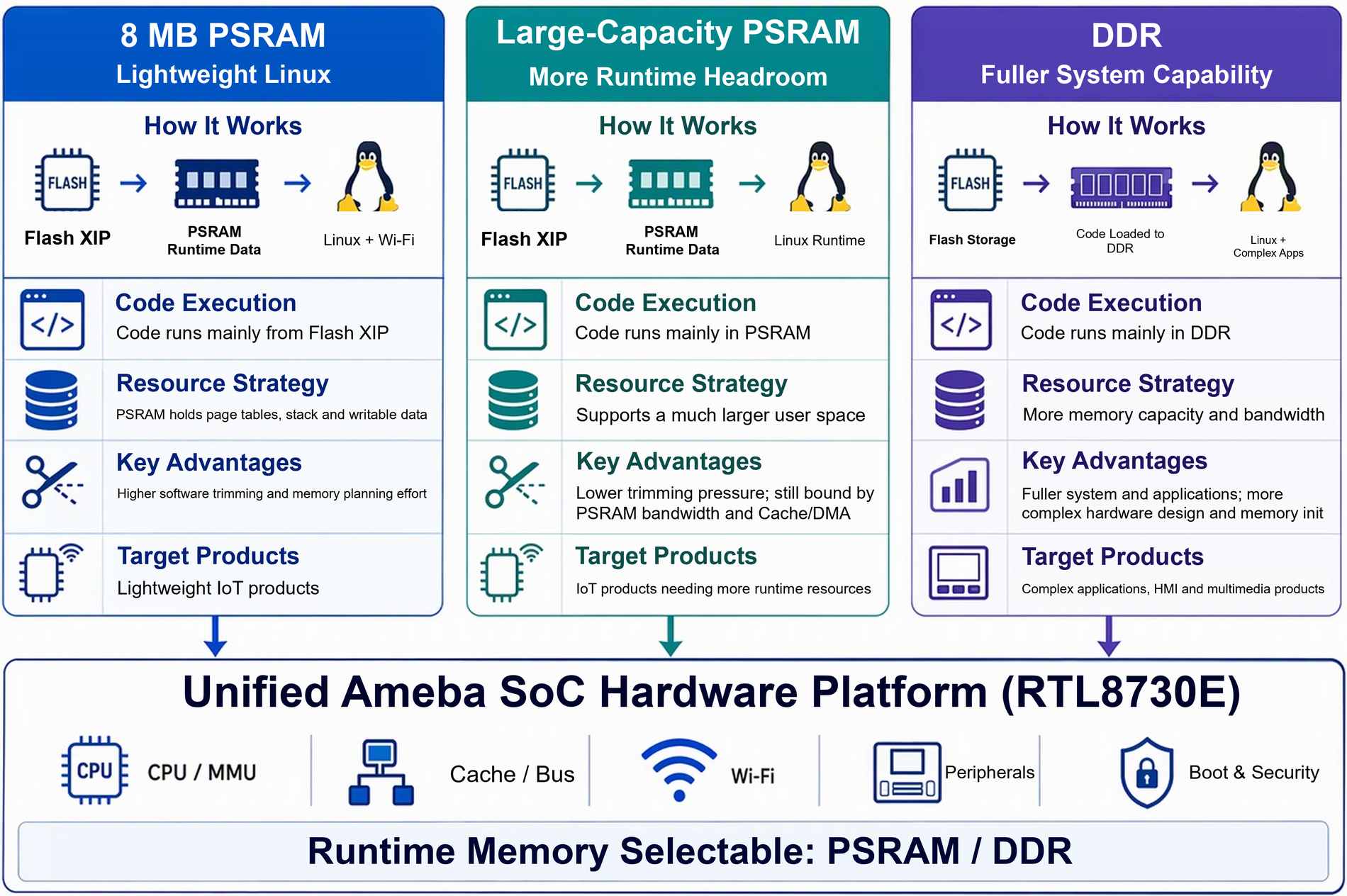
The PSRAM and DDR options together form the complete Ameba Linux portfolio: customers need not trade off between the Linux ecosystem, system capability, and hardware cost. They can select the hardware configuration and software option that match their requirements for cost, integration, runtime memory, bandwidth, and application complexity.
Advantages
Reuses the mature Linux kernel, BSP, Yocto build system, and standard software ecosystem, reducing low-level adaptation and system setup and accelerating entry into application development and product validation

The single-chip heterogeneous architecture removes the need for an external host processor, reducing external components and multi-chip coordination while greatly simplifying PCB layout, antenna design, and routing and lowering BOM complexity

DDR and PSRAM memory options provide matching combinations of capacity, bandwidth, integration, and cost, enabling flexible selection of system capability against hardware resources

Secure boot, version management, firmware flashing, system debugging, OTA updates, and failure recovery support continuous evolution from development validation through volume deployment and ongoing maintenance
Typical Applications
- Wireless audio/video endpoints: Combines dual-band Wi-Fi, Bluetooth/LE Audio, and Linux multimedia frameworks for smart speakers, wireless soundbars, multi-room audio, home entertainment, and wireless A/V devices—typically better suited to the DDR option.
- Edge AI gateways: Combines Linux application processing, network connectivity, local data processing, and lightweight inference frameworks for home, industrial, and retail device management; more complex application combinations generally favor the DDR option.
- Smart interactive terminals: Combines MIPI display, DRM/KMS, LVGL, voice algorithms, and local control for smart home hubs, appliance control panels, and industrial HMIs; the choice between DDR and PSRAM depends on UI complexity and runtime resource requirements.
- Lightweight connected endpoints: The PSRAM option retains Linux system capability and basic Wi-Fi connectivity, suited to resource-constrained, cost-sensitive IoT products that do not require a full multimedia stack.
Wireless Soundbar
For smart TVs and projectors; supports high-resolution wireless audio and direct Bluetooth connection to phones and computers
Home Entertainment Hub
Serves as the audio core of a home theater, delivering high-resolution streaming audio and compatibility with mainstream music and video platforms such as Spotify, Apple Music, and QQ Music
Appliance Control Panel
For smart home and appliance control, combining Linux graphics frameworks and display interfaces for status display, touch interaction, and local control
HMI Display Device
Integrates the AIVoice offline voice solution, Linux graphics frameworks, and display interfaces to support voice input, on-screen feedback, and local device control
Development Resources
| Icon | Resource | Link |
|---|---|---|
 |
Linux SDK Download | Link |
 |
Linux SDK Documentation | Link |
 |
Technical Consulting | Link |
Recommended ICs
| Features | Filter | RTL8720F | RTL8721F | RTL8721Dx | RTL8720E | RTL8710E | RTL8726E | RTL8713E | RTL8730E | RTL872xD | RTL8735B |
|---|---|---|---|---|---|---|---|---|---|---|---|
| Application Processor |
Cortex-M | Cortex-M | Cortex-M | Cortex-M | Cortex-M | Cortex-M | Cortex-M | Cortex-A | Cortex-M | Cortex-M | |
| DSP | N | N | N | N | N | Y | Y | N | N | N | |
| ISP | N | N | N | N | N | N | N | N | N | Y | |
| Arm TrustZone | Y | Y | Y | Y | N | Y | N | Y | Y | Y | |
| Dual Band | N | Y | Y | N | N | N | N | Y | Y | Y | |
| Wi-Fi 6 | Y | Y | N | Y | Y | Y | Y | Y | N | N | |
| R-MESH | Y | Y | Y | N | N | N | N | N | N | N | |
| Ultra-low Power | Y | Y | Y | N | N | N | N | N | Y | Y | |
| Ethernet | N | Y | N | N | N | N | N | N | N | N | |
| BT Dual Mode | N | N | N | N | N | Y | Y | Y | N | N | |
| HMI | N | Y | Y | Y | N | Y | Y | Y | N | N | |
| Audio ADC | N | N | N | N | N | Y | Y | Y | Y | Y | |
| Audio DAC | N | N | N | N | N | Y | Y | Y | Y | Y | |
| SDIO Host | N | Y | N | N | N | N | N | N | N | N | |
| SD/EMMC Host | N | Y | N | N | N | N | N | Y | Y | Y | |
| USB | N | Y | Y | N | N | N | N | Y | Y | Y | |
|
BT Dedicated Antenna |
N | N | N | N | N | N | N | Y | N | N | |
| CAN | N | Y | N | N | N | N | N | N | N | N |