Ameba HMI Smart Display Solutions
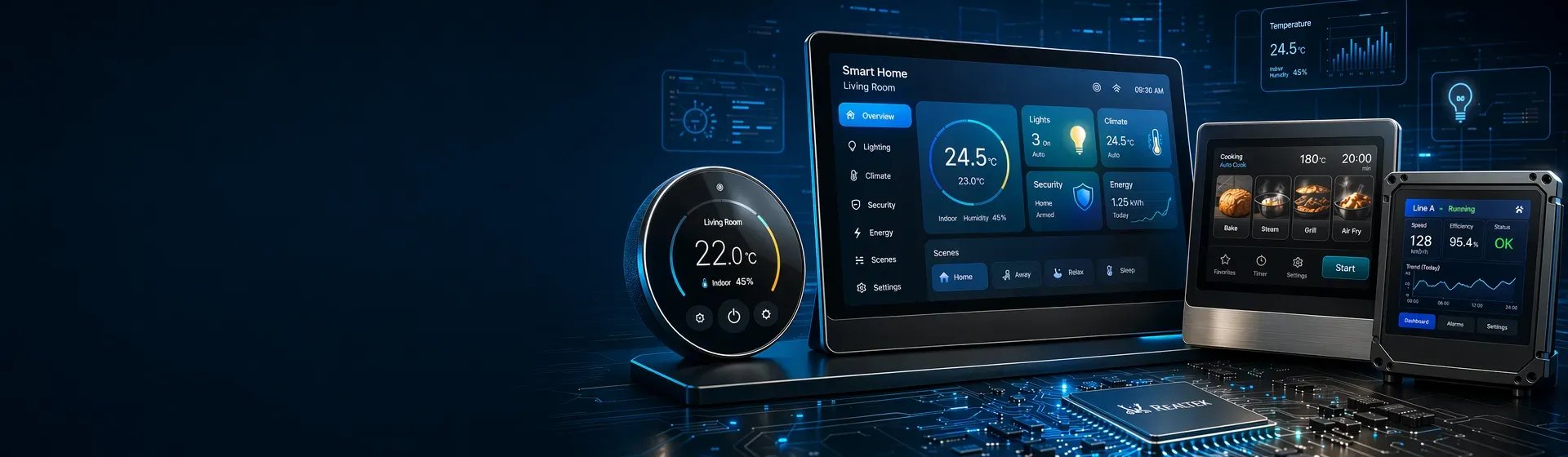
Comprehensive chip solutions, empowering countless display scenarios
Overview
Built on a simple idea—one screen, countless ways to interact—Ameba's HMI (Human-Machine Interface) smart-display solutions are powered by the RTL8721F, RTL8730E, RTL8721Dx and other models. From a smart-home hub that runs the whole household on one screen, to color-display upgrades for refrigerators, ovens, and washing machines, to a new layer of interactivity for medical monitors, industrial PLCs, and children's learning devices—across all of them, a comprehensive SDK delivers full-stack software support spanning silicon, system, and cloud. With FreeRTOS, Linux, and Zephyr all supported, it helps brands bring genuinely user-friendly, highly competitive smart devices to market.

Product Lineup
Ameba's graphics-capable chip portfolio spans multiple performance tiers—covering every form factor, from electronic shelf labels to robot HMIs.
| SoC | RTL8720E | RTL8713E | RTL8726E | RTL8721Dx | RTL8721F | RTL8730E |
|---|---|---|---|---|---|---|
| Graphics Performance | Lightweight | Lightweight | Lightweight | Advanced | Mainstream | High-Performance |
| Application Processor | Real-M300 up to 400 MHz |
Real-M300 up to 400 MHz |
Real-M300 up to 400 MHz |
Real-M300 up to 345 MHz |
Real-M300 up to 320 MHz |
Arm Cortex-A32 up to 1.2 GHz |
| Display Interface | SPI | SPI | SPI | QSPI | RGB | MIPI DSI |
| Max Resolution | 320×240 | 320×240 | 320×240 | 480×320 | 800×480 | 1024×600 |
| Memory System | 768KB SRAM QSPI NOR @100MHz DQ8 PSRAM @200MHz |
512KB SRAM QSPI NOR @100MHz DQ8 PSRAM @250MHz |
512KB SRAM QSPI NOR @100MHz DQ8 PSRAM @250MHz |
512KB SRAM QSPI NOR @104MHz DQ8 PSRAM @200MHz |
512KB SRAM QSPI NOR/NAND @104MHz DQ8/16 PSRAM @200MHz |
256KB SRAM QSPI NOR/NAND @100MHz DDR3L @533MHz |
| Wireless Connectivity | Wi-Fi 6 (2.4G) + BLE 5.x | Wi-Fi 6 (2.4G) | Wi-Fi 6 (2.4G) + Dual-Mode Bluetooth | Wi-Fi 4 Dual-Band + BLE 5.0 | Wi-Fi 6 Dual-Band + BLE 5.x | Wi-Fi 6 Dual-Band + Dual-Mode Bluetooth |
| Operating System | FreeRTOS | FreeRTOS | FreeRTOS | FreeRTOS / Zephyr | FreeRTOS / Zephyr | Linux / FreeRTOS / Zephyr |
| Target Scenarios | Knob displays, small displays | Knob displays, small displays | Knob displays, small displays | Electronic shelf labels, sensor panels, low-power meters, smart-lock sub-displays | Appliance panels, basic control hubs, two-wheeler dashboards, portable medical devices | High-end smart-home hubs, robot HMIs, streaming media devices, automotive sub-displays |
Software Stack
A complete SDK, a deeply ported LVGL engine, multi-OS support, and production-grade demos—every line of source code ships in the Ameba SDK.
Ameba SDK
Every screen, running at the speed Ameba was built for.
- All-in-one development kit: drivers, middleware, and sample projects integrated and ready out of the box
- Clean, layered architecture: HAL → Driver → Demo—porting to a new platform touches just one layer
- Full lineup, one codebase: adapted across the RTL8721Dx / RTL8726E / RTL8721F / RTL8730E / RTL8720E / RTL8713E, with a decoupled driver layer for zero-cost cross-chip porting
- Flexible display interfaces: QSPI, RGB, and MIPI DSI all supported, with seamless switching between portrait and landscape
- Hassle-free upgrades: hardware revisions and form-factor changes need no rewrite of your application code
Plug-and-Play Multi-Display
- Unified interface abstraction: swap panels or chips without touching application logic
- Automatic parameter negotiation: resolution, color depth, and refresh rate matched on the fly
- Presets for mainstream panels: common displays work out of the box
- No low-level expertise required: stay focused on UI and product logic
Deeply Integrated LVGL
- In step with mainline: tracks the upstream community, so upgrades stay smooth
- Hardware-accelerated rendering: cuts CPU usage by up to 60%
- 30+ built-in widgets: buttons, sliders, lists, charts, and animations
- Lean footprint: a compact, configurable core that fits resource-constrained MCUs
Multi-OS Support
- FreeRTOS: a lightweight real-time OS
- Zephyr: a modern driver architecture
- Linux: runs natively on the RTL8730E's Cortex-A32 SoC
Ready-to-Run Demos
- Widgets: 30+ interactive UI components on display
- Music: animations and smooth list scrolling in one demo
- Benchmark: a rendering-performance test
- Stress: extreme-load testing—fully open source
Hardware Accelerators
The Ameba family integrates several dedicated graphics-acceleration engines—leaner on entry-level parts, all-out on the flagships—and even chips without a full accelerator are backed by deep software optimization.
PPE — Pixel Processing Engine
A 2D pixel-processing engine that uses dedicated hardware to accelerate pixel-format conversion, geometric transforms, multi-layer blending, and color keying, reducing CPU load effectively.
- Multi-layer blending: composite up to 3 input layers onto a single result layer, with background-blend support for flexible layered compositing
- Pixel-format conversion: hardware conversion across color spaces such as RGB565 and ARGB8888, configurable independently for input and result layers
- Geometric transforms: 90°/180°/270° rotation plus smooth scaling for flexible multi-resolution UI
- Color keying: make pixels of a chosen color transparent, with a flexible transparency range for easy compositing
- Multi-frame automation: the hardware processes multiple frames back-to-back, with no constant CPU intervention
MJPEG Hardware Decoder
A JPEG decoder paired with a post-processing unit that can run independently or in tandem—carrying images all the way from decode, rotation, and scaling through color conversion to blended output entirely in hardware, with almost no CPU involvement.
- High-resolution decoding: hardware JPEG decoding up to 8176×8176 per frame, compatible with mainstream image formats
- Hardware rotation & scaling: 90°/180°/270° rotation, horizontal/vertical flip, and high-quality smooth scaling (up to 3× upscale) in a single pass
- Color-space conversion: hardware color-format conversion that follows international color standards for accurate color reproduction
- Blending & adjustment: dual-region alpha blending and picture-in-picture, plus brightness / contrast / saturation control and image cropping
- Typical scenarios: boot animations, HD backgrounds, and dynamic visuals—decode-to-display, seamlessly integrated with LVGL
LCDC — LCD Controller
An on-chip LCD controller that is highly configurable and includes a built-in pixel-format converter, adapting effortlessly to a wide range of display panels and resolutions for a flexible, efficient embedded display path.
- Dual interface support: RGB parallel and 8080 (I80/MCU) interfaces for flexible panel connectivity
- Rich pixel formats: native RGB565 / RGB888 across 6-, 8-, 16-, and 24-bit outputs
- Programmable timing: all display timing and signal parameters are fully configurable—matching panel specs from any vendor
- Built-in pixel-format conversion: native hardware conversion between color formats with no CPU involvement
- Broad resolution support: a wide range of panel resolutions, with 8080-interface TE signaling for tear-free updates
Advantages
The Ameba HMI solution advances on three fronts at once—developer experience, cross-chip portability, and hardware-software synergy—giving brands a smart-display platform that is genuinely ready to ship.
- Complete Ameba SDK: full-stack software support from silicon to system to cloud, with comprehensive how-to and design docs that make building smart-display devices straightforward
- Deep LVGL integration: full support for LVGL-based GUI development, including LVGL's official visual design tool, LVGL Pro
- One-command demos: switch between built-in demos—Widgets / Music / Benchmark / Stress—straight from the menuconfig UI, for instant validation with zero project changes
- Layered, decoupled porting architecture: the LVGL rendering core, the porting layer, and your application code are all fully reusable across chips, with silicon-specific differences isolated in the HAL—moving to a new platform means rewriting only the HAL
- Every interface path covered: a single project spans value-tier QSPI, mainstream RGB, and premium MIPI DSI—keeping your UI reusable through hardware upgrades and form-factor changes
- Hardware accelerators: the PPE pixel-processing engine, the MJPEG hardware decoder, and the LCDC display controller work in parallel, cutting CPU usage by up to 60%
- Automatic software adaptation: the software layer detects each chip's capabilities—accelerators when available, optimized paths when not—switching transparently to developers
- Consistent cross-chip experience: the UI project migrates from Cortex-M entry parts to Cortex-A flagships with zero changes, rendering smoothly throughout
Typical Applications
The three different interfaces represent three distinct technical paths and market positions, allowing for optimal selection based on project requirements.
- Smart Home Appliance Panels (Refrigerators, AC Units, Washing Machines, etc.)
- Basic Smart Control Panels
- Two-Wheeler Dashboards
- Consumer Electronics (Portable Medical Devices, Smart Speakers with Display)
Smart Home Appliance Panels
Refrigerators, AC Units, Washing Machines, etc.
Basic Smart Control Panels
Two-Wheeler Dashboards
Consumer Electronics
Portable Medical Devices, Smart Speakers with Display
- High-End Smart Home Hubs
- High-End Smart Robots
- Streaming Media Display Devices
High-End Smart Home Hubs
High-End Smart Robots
Streaming Media Display Devices
- Electronic Shelf Labels (ESL)/Smart Labels
- Smart Home Sensor Panels
- Low-Power Smart Meters
Electronic Shelf Labels (ESL)/Smart Labels
Smart Home Sensor Panels
Low-Power Smart Meters
Development Resources
| Icon | Resource Name | Link |
|---|---|---|
 |
SDK Download | Link |
 |
HMI Development Guide | Link |
 |
Contact Us | Link |
Recommended ICs
| Features | Filter | RTL8720F | RTL8721F | RTL8721Dx | RTL8720E | RTL8710E | RTL8726E | RTL8713E | RTL8730E | RTL872xD | RTL8735B |
|---|---|---|---|---|---|---|---|---|---|---|---|
| Application Processor |
Cortex-M | Cortex-M | Cortex-M | Cortex-M | Cortex-M | Cortex-M | Cortex-M | Cortex-A | Cortex-M | Cortex-M | |
| DSP | N | N | N | N | N | Y | Y | N | N | N | |
| ISP | N | N | N | N | N | N | N | N | N | Y | |
| Arm TrustZone | Y | Y | Y | Y | N | Y | N | Y | Y | Y | |
| Dual Band | N | Y | Y | N | N | N | N | Y | Y | Y | |
| Wi-Fi 6 | Y | Y | N | Y | Y | Y | Y | Y | N | N | |
| R-MESH | Y | Y | Y | N | N | N | N | N | N | N | |
| Ultra-low Power | Y | Y | Y | N | N | N | N | N | Y | Y | |
| Ethernet | N | Y | N | N | N | N | N | N | N | N | |
| BT Dual Mode | N | N | N | N | N | Y | Y | Y | N | N | |
| HMI | N | Y | Y | Y | N | Y | Y | Y | N | N | |
| Audio ADC | N | N | N | N | N | Y | Y | Y | Y | Y | |
| Audio DAC | N | N | N | N | N | Y | Y | Y | Y | Y | |
| SDIO Host | N | Y | N | N | N | N | N | N | N | N | |
| SD/EMMC Host | N | Y | N | N | N | N | N | Y | Y | Y | |
| USB | N | Y | Y | N | N | N | N | Y | Y | Y | |
|
BT Dedicated Antenna |
N | N | N | N | N | N | N | Y | N | N | |
| CAN | N | Y | N | N | N | N | N | N | N | N |