Ameba Rust Solutions
Dual-core chip meets Rust, building connected applications safely and efficiently
Overview
Ameba Rust SDK is Realtek's official Rust firmware development kit for Ameba dual-core Wi-Fi SoCs. Rust runs on the application core, while the network core runs Realtek prebuilt Wi-Fi firmware, with the two cores communicating over IPC. On top of this, the SDK provides a complete application-side stack as Rust crates, from peripheral drivers, Wi-Fi connectivity and TCP/IP networking to flash storage and OTA updates, so connected products can be developed entirely in Rust.
With a strict no_std design, the SDK follows standard Rust embedded interfaces such as embedded-hal, embedded-io and embedded-storage, so community drivers and libraries can be reused directly, and it brings the compile-time memory safety of Rust's ownership model.
Features
Rust applications run on the application core, while low-level Wi-Fi protocol processing and radio communication are handled by Realtek prebuilt firmware on the network core without consuming application-core resources, with the two cores communicating over IPC. Developers get full wireless connectivity without porting a Wi-Fi stack.

The HAL covers GPIO, UART, SPI, I2C, ADC, DMA, PWM, CAN, Ethernet, SD Host, RTC, watchdog, TRNG, thermal sensor and more. Wi-Fi supports STA and SoftAP modes with WPA2/WPA3 security, and smoltcp / embassy-net provide TCP, UDP and DHCP. NOR flash storage and A/B dual-slot OTA updates (with HTTP download) complete the stack, so everything from hardware control to over-the-air updates is done in Rust.

GPIO, I2C, SPI, PWM and delay implement embedded-hal / embedded-hal-async, UART implements embedded-io / embedded-io-async, flash storage implements embedded-storage, and Wi-Fi implements embassy-net-driver. Community sensor and display drivers, as well as HTTP, MQTT and other networking libraries from the embassy-net ecosystem, plug in directly with less custom code. Other peripherals such as ADC, DMA, CAN and RTC provide Ameba-specific Rust APIs.

With Embassy's cooperative async scheduling, Wi-Fi events, network communication and sensor sampling can each be written as an independent async task, without RTOS threads and their per-task stacks. This saves memory and keeps concurrent logic easy to follow. Drivers also offer a blocking mode for simpler timing needs.

ameba-generate creates a new application project in one step (chip, Embassy, Wi-Fi options), and cargo xtask with ameba-flash handles building, packaging, flashing and serial log monitoring. The whole workflow runs through cargo, which makes local development and CI integration straightforward.

Rust's ownership model and borrow checker eliminate dangling pointers, data races and other memory errors at compile time. The SDK extends this to hardware access: the PAC generates strongly-typed register accessors from the chip's SVD, and GPIO modes, Timer modes and I2C/SPI/UART blocking/async modes are encoded in types, so misuse is caught at compile time and less time is spent debugging on the board.
Architecture
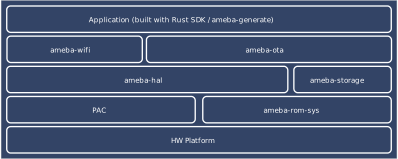
The Rust SDK targets the App firmware on the application core. The Bootloader and network-core Wi-Fi firmware are ameba-rtos prebuilt binaries.
The App firmware is layered: PAC and ROM FFI (ameba-rom-sys) at the base, the HAL (ameba-hal) on both, and Wi-Fi (ameba-wifi), storage (ameba-storage) and OTA (ameba-ota) on top. Applications also link the startup crate ameba-rt.
Crates are linked only when used, keeping firmware size under control. Code can bypass the HAL to access PAC registers directly, and the layering follows Rust embedded conventions, so community crates plug in at the matching layer.
Development Resources
| Icon | Resource Name | Link |
|---|---|---|
 |
Quick Start | LINK |
 |
Rust Development Guide | LINK |
 |
GitHub Source Code (ameba-rust) | LINK |
 |
Contact Us | LINK |
Recommended ICs
| Features | Filter | RTL8720F | RTL8721F | RTL8721Dx | RTL8720E | RTL8710E | RTL8726E | RTL8713E | RTL8730E | RTL872xD | RTL8735B |
|---|---|---|---|---|---|---|---|---|---|---|---|
| Application Processor |
Cortex-M | Cortex-M | Cortex-M | Cortex-M | Cortex-M | Cortex-M | Cortex-M | Cortex-A | Cortex-M | Cortex-M | |
| DSP | N | N | N | N | N | Y | Y | N | N | N | |
| ISP | N | N | N | N | N | N | N | N | N | Y | |
| Arm TrustZone | Y | Y | Y | Y | N | Y | N | Y | Y | Y | |
| Dual Band | N | Y | Y | N | N | N | N | Y | Y | Y | |
| Wi-Fi 6 | Y | Y | N | Y | Y | Y | Y | Y | N | N | |
| R-MESH | Y | Y | Y | N | N | N | N | N | N | N | |
| Ultra-low Power | Y | Y | Y | N | N | N | N | N | Y | Y | |
| Ethernet | N | Y | N | N | N | N | N | N | N | N | |
| BT Dual Mode | N | N | N | N | N | Y | Y | Y | N | N | |
| HMI | N | Y | Y | Y | N | Y | Y | Y | N | N | |
| Audio ADC | N | N | N | N | N | Y | Y | Y | Y | Y | |
| Audio DAC | N | N | N | N | N | Y | Y | Y | Y | Y | |
| SDIO Host | N | Y | N | N | N | N | N | N | N | N | |
| SD/EMMC Host | N | Y | N | N | N | N | N | Y | Y | Y | |
| USB | N | Y | Y | N | N | N | N | Y | Y | Y | |
|
BT Dedicated Antenna |
N | N | N | N | N | N | N | Y | N | N | |
| CAN | N | Y | N | N | N | N | N | N | N | N |