Ameba Arduino Solutions

Open-source prototyping with Ameba wireless connectivity, easily bringing creative electronics to life
Overview
Arduino® is an open-source electronics prototyping platform based on open hardware and software. It mainly consists of a variety of microcontroller development boards and a simplified C/C++ programming environment (Arduino IDE), designed to lower the barrier to developing interactive electronic projects.
It features low entry requirements, open-source nature, high extensibility, and low cost. Users can quickly get started without extensive electronics or programming knowledge. It can connect to various sensors and actuators, and is widely used in education, DIY maker projects, IoT development, industrial prototype verification, and interactive art design. Arduino is one of the world’s most popular tools for realizing creative electronics projects.
Features
Ameba IoT wireless solutions, featuring high integration, stable performance, low power consumption, and enhanced security. It is specifically designed for optimized power efficiency, RF performance, and low-power consumption. With Arduino, users can easily build electronic projects for various scenarios.

Arduino Software (including the core library and Integrated Development Environment IDE) is licensed under the GNU Lesser General Public License v2.1 (LGPL v2.1). This license permits all users to modify and distribute the Arduino Software, supporting collaborative development and innovative growth of the open-source community.

A user-friendly platform with simple syntax and clear wiring for development boards. It offers abundant libraries, tutorials, and sample code that greatly simplify the development process. Even beginners can get started quickly, enabling rapid customization and iteration of products, services, and businesses, and promoting the efficient implementation and continuous optimization of innovative projects.

It integrates essential features for IoT development such as peripheral interfaces, secure boot, hardware encryption engines (AES/SHA), debug password protection, Wi-Fi, and BLE. Different ICs are also equipped with a wealth of enhanced features to meet diverse application requirements and help users create more innovative products.

Arduino Core & API form a complete software component system, providing underlying support for developers to interact with hardware and write programs in the Arduino development environment. Ameba supports the standard Arduino API to ensure consistency and convenience in development.

Arduino has a vibrant global development community that brings together content creators, technical experts, and developers from all walks of life. Regardless of their learning and development stage, developers can easily access a wealth of documents, videos, project examples, and tutorial resources in the community, enjoying comprehensive development support and services throughout the entire process.
Architecture
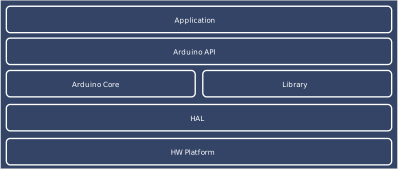
Ameba Arduino adopts the layered architecture shown in the diagram. The Hardware Abstraction Layer (HAL) is deployed on top of the hardware platform, shielding the underlying hardware details and providing hardware abstraction support for the Arduino Core and Libraries.
The Arduino Core and Libraries represent the concrete implementation of the Arduino API, which provides a unified and standardized interface for upper-layer applications, enabling users to develop a variety of IoT and embedded projects efficiently and conveniently.