Introduction
The watchdog timer is a hardware-level safety monitoring module used to detect and recover from software faults (such as infinite loops, code runaway, bus hangs). When system software fails to perform the watchdog feeding operation (refreshing the counter) within the specified time, the WDG will time out and trigger a reset signal, forcing the corresponding CPU or the entire system to reboot, ensuring reliability and recoverability under abnormal conditions.
In the Ameba series SoC, the watchdog is divided into two categories: independent watchdog (IWDG) and system watchdog (SWDG):
Independent watchdog: Operates with an independent clock source, does not rely on the system main clock, and is not affected by low-power modes or main clock configurations. It can serve as a global fault monitor shared by dual cores, and can trigger a system-level reset upon timeout.
System watchdog: Bound to the CPU. In a multi-core system, each CPU is configured with a dedicated system watchdog. For CPUs that support TrustZone, independent secure watchdog (Secure WDG) and non-secure watchdog (Non-secure WDG) are also provided, used for fault monitoring of secure domain and non-secure domain firmware respectively, enabling hierarchical fault isolation and handling.
All watchdogs support dual paths of timeout interrupt and reset. An interrupt can first notify the software for fault diagnosis and remediation. If the fault is not handled, a reset signal will be output upon timeout, implementing a multi-level recovery strategy ranging from single-core reset to system-wide global reset.
IWDG: System independent watchdog timer
WDG0: Watchdog timer for KM0
WDG1: Secure watchdog timer for KM4
WDG2: Non-secure watchdog timer for KM4
The watchdog architecture is shown in the following figure.

IWDG: System independent watchdog timer
WDG1: Secure watchdog timer for KM4
WDG2: Non-secure watchdog timer for KM4
WDG3: Watchdog timer for KR4
The watchdog architecture is shown in the following figure.

IWDG: System independent watchdog timer
WDG2: Non-secure watchdog timer for KM4
WDG3: Watchdog timer for KR4
The watchdog architecture is shown in the following figure.

IWDG: System independent watchdog timer
WDG1: Secure watchdog timer for KM4
WDG2: Non-secure watchdog timer for KM4
WDG3: Watchdog timer for KR4
WDG4: Watchdog timer for DSP
The watchdog architecture is shown in the following figure.

IWDG: System independent watchdog timer
WDG2: Non-secure watchdog timer for KM4
WDG3: Watchdog timer for KR4
WDG4: Watchdog timer for DSP
The watchdog architecture is shown in the following figure.

IWDG: System independent watchdog timer. Dedicated for KM0.
WDG1: Secure watchdog timer for KM4
WDG2: Non-secure watchdog timer for KM4
WDG3: Secure watchdog timer for CA32
WDG4: Non-secure watchdog timer for CA32
The watchdog architecture is shown in the following figure.

IWDG: System independent watchdog timer
WDG0: Watchdog timer for KM4_NS
WDG1: Secure watchdog timer for KM4_TZ
WDG2: Non-secure watchdog timer for KM4_TZ
The watchdog architecture is shown in the following figure.

IWDG: System independent watchdog timer
WDG0: Watchdog timer for KM4_NS
WDG1: Secure watchdog timer for KM4_TZ
WDG2: Non-secure watchdog timer for KM4_TZ
The watchdog architecture is shown in the following figure.
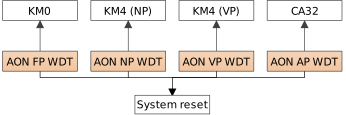
AON FP WDT: Watchdog timer for KM0
AON NP WDT: Watchdog timer for KM4 (NP)
AON VP WDT: Watchdog timer for KM4 (VP)
AON AP WDT: Watchdog timer for CA32
The watchdog architecture is shown in the following figure.
Independent Watchdog Timer
Introduction
The independent watchdog (IWDG) is a system-level safety monitoring module driven by an always-on power domain and a 100 kHz uncalibrated internal clock. The power domain and clock cannot be disabled after system startup, so once the IWDG is enabled (whether by hardware or software), software cannot disable it.
The IWDG’s 100 kHz clock is an uncalibrated internal oscillator with a frequency tolerance of ±50%. When configuring the timeout period and feeding strategy, software must reserve sufficient margin to avoid unexpected resets. To prevent mistriggers caused by feeding timing deviations, enabling the IWDG window function is not recommended.
The IWDG behavior in sleep mode can be configured via the LPEN bit in the control register: when set, the IWDG continues counting in sleep mode, and a timeout will trigger a system-level reset; the configured early interrupt can wake up the system. When LPEN is cleared, the IWDG stops counting in sleep mode and holds its current state, resuming counting after wakeup. The IWDG is reset upon entering deep sleep.
OTP can be configured to auto-load an AON register, enabling the IWDG automatically by hardware. This register only supports writing from 0 to 1 (a one-time operation). Once configured, the IWDG will automatically run after initial boot or deep sleep wakeup, and software cannot intervene or disable it.
The independent watchdog (IWDG) of this chip is implemented by the AON watchdog timers (AON WDT). Each AON WDT is driven by the always-on power domain. This chip provides four AON WDTs, which monitor KM0, KM4 (NP), KM4 (VP) and CA32 respectively. By default, a timeout resets the whole system.
Each AON WDT is controlled by a single timer register. For details, refer to the Registers section.
Software can also trigger a system reset immediately by setting the reset trigger bit (WDT_RST_TRIG) of the AON WDT.
Features
Once enabled, it cannot be disabled
Optional early interrupt that can generate an interrupt at a programmable time before watchdog timeout
Independent wakeup source
Powered and clocked by the AON (always-on) power domain
Automatically pauses counting when the CPU is in debug mode
Configurable operation in sleep mode
Four AON WDTs for KM0, KM4 (NP), KM4 (VP) and CA32
Powered and clocked by the AON (always-on) power domain
16-bit counter and 10-bit pre-scaler factor
Can be enabled and stopped by software
Software can trigger a system reset
System Watchdog Timer
Introduction
The system watchdog (SWDG) is a dedicated safety monitoring module for the CPU core, sharing the power domain with the corresponding CPU core. It is driven by an internal 32 kHz OSC clock, providing fault detection and recovery capabilities for the CPU operating state.
The system watchdog supports a windowed watchdog function, which can be configured to allow watchdog feeding only within a specified window range of the counter. If the feeding timing is too early or too late, a system reset identical to that triggered by a timeout event will occur, thereby enabling strict monitoring of software execution timing.
In sleep mode, the system watchdog stops counting and maintains its current state. Counting resumes after the system wakes up. When entering deep sleep mode, the system watchdog is reset. Therefore, after waking up from deep sleep, the module must be reconfigured and enabled by software.
Features
Once enabled, cannot be disabled
Optional early interrupt that can generate an interrupt at a programmable time before watchdog timeout
Independent wakeup source
Powered by SYSON domain and SDM32K clock source
Automatically pauses counting when the CPU is in debug mode