The Real-Time Clock (RTC) is an independent BCD-format timer/counter. As a core low-power timing peripheral of the chip, it provides continuous timekeeping, precise timing, and security protection capabilities. It can maintain uninterrupted operation across all chip operating states, meeting the needs of embedded devices for time management, low-power wakeup, and timed triggering.
The RTC of the Ameba series SOC implements only time and date counting; calendar and year management are handled by software. It supports a digital calibration feature for time correction, is equipped with backup registers that retain data even in deep sleep mode, and supports daylight saving time compensation, scheduled wakeup, and periodic wakeup functions.
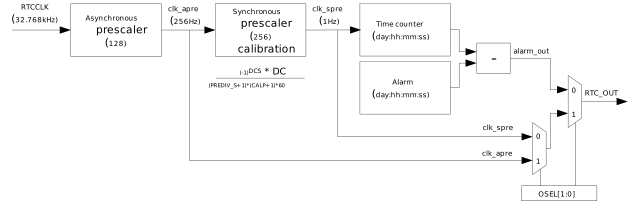
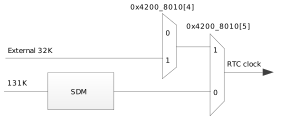
The RTC module uses SDM32K as the clock source, generates a time base through two-stage frequency division and calibration, and provides time counting, alarm, and multiple clock output functions.
Clock Chain
The input clock RTCCLK(32.768kHz) first passes through an asynchronous prescaler (division factor 128), outputting a 256 Hz clk_apre signal.
clk_apre then enters a synchronous prescaler with calibration capability (division factor 256), ultimately generating a 1 Hz clk_spre signal as the reference clock for the time counter.
The synchronous prescaler supports frequency calibration, fine-tuning the output frequency through the formula (-1)^DCS*DC/((PREDIV_S+1)*(CALP+1)*60) to compensate for crystal oscillator errors.
Time Counting and Alarm
The time counter uses clk_spre(1Hz) as the clock, incrementing in day:hh:mm:ss format to maintain system time.
The alarm module supports configuring alarm time in day:hh:mm:ss format. When the time counter matches the alarm register value, an alarm_out signal is output, which can be used to trigger an interrupt or wakeup event.
Output Selection
The final output RTC_OUT of the RTC module is configured by OSEL[1:0], which can output clk_spre(1Hz), clk_apre(256Hz), or alarm_out signal to meet clock or event output requirements in different application scenarios.
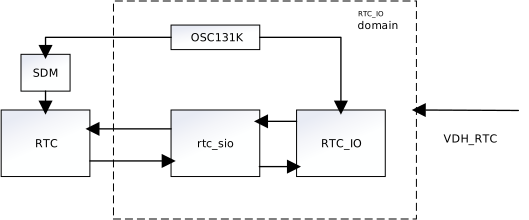
VDH_RTC is the independent power supply pin for the RTC_IO module, available only in certain packages. Users can design a separate power supply circuit for this pin. When the main chip power is on, the RTC will periodically and automatically back up to RTC_IO. When the main chip power is off, RTC_IO will continue counting using the OSC131K clock domain. After the main system power is restored, SW processing time is required to recover and maintain system time continuity. During the power-off operation of the main system, the RTC timing accuracy is limited by the inherent accuracy of the OSC131K clock; this oscillator is calibrated once by software during power-on, but due to its process characteristics, the actual timing error during power-off operation may be higher than the nominal value at the time of calibration.
RTC_IO
Overview
VDH_RTC can independently power the OSC131K and RTC_IO circuits to continue timekeeping when the system main power is off. RTC_IO has an internal memory to store time data obtained from the RTC, as well as a counter. RTC_IO periodically reads RTC time data and saves it to the RTC_IO module’s memory, while also resetting the counter.
When RTC_IO detects a main power loss, it stops reading RTC time and continues timekeeping using the internal counter. When the system powers on again, SW needs to read back the RTC time before power-off and the counter value to restore the system RTC time.
The RTC domain diagram is shown in the following figure.
Features
rtc_sio transmits RTC time data to the RTC_IO module in the RTC module at an interval of 1/256s.
The RTC_IO module retains RTC time data and count during power-off.
The OSC32K calibration value LDO_RCAL can be retained in the RTC_IO domain to maintain the OSC32K calibration function during power-off.
Operation Flow
To shift LDO_RCAL into RTC_IO and shift out time data from RTC_IO, perform the configuration steps illustrated in the following table.
Step
What to do
How to do
1
Manually put RTC_IO into rtc_mode (optional)
Write 2’d2 to register rtc_io_ctrl[1:0]
2
Acquire LDO_RCAL[5:0] value
Read register LDO_BASE-> LDO_32K_OSC_CTRL[5:0]
3
Prepare data into the register that will be shifted into RTC_IO
Write step 2’s value to register rtc_io_test_din[63:58]
4
Enter MODE_SHIFT_ENABLE mode to start shift operation
Write 2’d1 to register rtc_io_ctrl[1:0]
5
Wait some time for rtc_sio to send command to RTC_IO
Wait 15ms
6
Read the stored time data and counter for further processing
Read registers rtc_io_test_dout[127:0]
7
Enter MODE_SHIFT_DISABLE mode to allow HW to recover periodic update of RTC time data into shd_reg
Write 2’d0 to register rtc_io_ctrl[1:0]
8
Process the read-back time data in step 6
Acquire the time data read from rtc_io_test_dout
Parse the stored time and separate it into sec, min, hour, day and year
Parse the counter during power-off period
Calculate new time and set it to the device
To calculate the new time, the following formula can be referenced:
However, some complex situations need to be taken into consideration, such as seconds carrying over to minutes, minutes carrying over to hours, leap year, etc.
Note
The command that rtc_sio sends to RTC_IO in step 4 takes 5.78ms when osc131k has no frequency deviation.
If the RTC module initializes the time format in 12-hour format, the RTC_IO module will convert it to 24-hour format and store it. Therefore, when parsing the respective time fields and calculating the new time, this format conversion needs to be considered.
Registers
Name
Address
Width
Description
REG_AON_RTC_IO_CTRL
0x41008048
32 bits
0x41008048[4]: RTC IO mode flag (Read Only)
1: RTC IO domain enabled
0: Disabled (default)
0x41008048[1:0]: RTC IO control mode (R/W)
0: Shift disable
1: Shift enable
2: RTC mode (once enable , it can’t be disabled)
rtc_io_test_din
0x420080E0
128 bits
0x410080E0[63:58]: LDO_RCAL value
receive LDO_RCAL value written by software
rtc_io_test_dout
0x410080C0
128 bits
0x410080C0[33:0]: Binary storage for year/day/hour/minute/second (e.g.: 33sec saved as sec[5:0]=6’b10_0001)
sec: 6’b0; 0x4100_80C0[5:0]
min: 6’b0; 0x4100_80C0[11:6]
hour: 5’b0; 0x4100_80C0[16:12]
day: 9’b0; 0x4100_80C0[25:17]
year: 8’b0; 0x4100_80C0[33:26]
0x410080C0 [83:42]: Counter during power-off period, the counter clock is OSC131K.
RTL8720E:
System-powered, without independent power supply.
RTL8710E:
System-powered, without independent power supply.
RTL8726E:
System-powered, without independent power supply.
RTL8713E:
System-powered, without independent power supply.
RTL8730E:
System-powered, without independent power supply.
RTL8721F:
VDH_RTC is a dedicated power supply pin for the RTC module, available only in certain packages. Users can design an independent power supply circuit for this pin. When the main system power is off, the RTC automatically switches to the OSC131K/4 clock to continue timekeeping. When the main system power is restored, it automatically switches back to the SDM32K clock to continue timekeeping, maintaining system time continuity. During main system power-off operation, RTC timekeeping accuracy is limited by the inherent accuracy of the OSC131K clock. This oscillator is calibrated once by software during power-up, but due to its process characteristics, the actual timekeeping error during main system power-off operation will be higher than the nominal value at calibration.
A programmable prescaler stage generates a 1Hz clock which is used to update the calendar. To minimize power consumption, the prescaler is split into 2 programmable prescalers.
A 9-bit asynchronous prescaler configured through the PREDIV_A bits of the RTC_PRER register.
A 9-bit synchronous prescaler configured through the PREDIV_S bits of the RTC_PRER register.
Note
It is recommended to configure the asynchronous prescaler to a high value to minimize consumption.
By default, the asynchronous prescaler division factor is set to 128, and the synchronous division factor is set to 256, to obtain an internal clock frequency of 1Hz (clk_spre) with 32.768kHz as RTCCLK.
The programmable alarm function is enabled through the ALME bit in the RTC_CR register. The ALMF is set to ‘1’ if the calendar seconds, minutes, hours or days match the values programmed in the alarm registers RTC_ALMR1L and RTL_ALMR1H. Each calendar field can be independently selected through the MSKx bits. The alarm interrupt is enabled through the ALMIE bit in the RTC_CR register.
Alarm (if enabled by the OSEL [1:0] bits in RTC_CR) can be routed to the RTC_OUT output except when system is in deepsleep mode. The alarm output is a pulse which width is 1/RTCCLK.
The digital calibration can be used to compensate RTCCLK inaccuracy by adding (positive calibration) or masking (negative calibration) clock cycles at the output of the asynchronous prescaler (clk_apre).
Positive and negative calibrations are selected by setting the DCS bit to ‘0’ and ‘1’ in RTC_CALIBR register, respectively.
When positive calibration is enabled (DCS = ‘0’), DC clk_apre cycles are added every (CALP + 1) minutes, which causes the calendar to be updated sooner, thereby adjusting the effective RTC frequency to be a bit higher.
When negative calibration is enabled (DCS = ‘1’), DC clk_apre cycles are removed every (CALP + 1) minutes, which causes the calendar to be updated later, thereby adjusting the effective RTC frequency to be a bit lower.
DC and CALP can be configured through the RTC_CALIBR register. DC must be less than PREDIV_S in the RTC_PRER register.
The calibration parameter can be configured on-the-fly. Calibration resolution is determined by the frequency of clk_apre and the calibration period. The formula is as follows:
resolution = period_clk_apre / calp
CALP
clk_apre (128Hz)
clk_apre (256Hz)
clk_apre (512Hz)
1 min.
130.2ppm
65.1ppm
32.55ppm
2 min.
65.1ppm
32.55ppm
16.27ppm
4 min.
32.55ppm
16.27ppm
8.14ppm
8 min.
16.27ppm
8.14ppm
4.07ppm
Re-calibration on-the-fly:
The calibration register (RTC_CALIBR) can be updated on-the-fly while INITF = 0, by following these steps:
Poll the RECALPF (re-calibration pending flag).
If RECALPF is set to 0, write a new value to RTC_CALIBR if necessary; RECALPF is then automatically set to 1.
Within three clk_apre cycles after the write operation to RTC_CALIBR, the new calibration settings take effect.
The RTC provides a day interrupt for users. When the day interrupt is needed, DAY_THRES [8:0] must be programmed first in RTC_CR, and then the DOVTHIE bit in RTC_CR must be set to enable the day over-threshold interrupt.
The daylight saving time management is performed through the SUB1H, ADD1H, and BKP bits of the RTC_CR register.
Using SUB1H or ADD1H, the software can subtract or add one hour to the calendar in a single operation without going through the initialization procedure. In addition, the software can use the BKP bit to memorize this operation. It is recommended not to change the hour during the calendar hour increment as it could mask the incrementing of the calendar hour. (HW can handle this condition; if this condition occurs, HW will delay the SUB1H or ADD1H operation for 1 second.) When the calendar hour is 0 in the 24-hour system, SUB1H is not supported.
There are two types of RTC output pins which are in different power domains. One type is in the AON domain, which has power in active, sleep, and deep sleep modes. The other type is in the SYSON domain, which can output in active mode and sleep mode, but has no power and cannot output in deep sleep mode. If it had output before, the output continues after wakeup from deep sleep.
The output of rtc_out is determined by the OSEL [1:0] bits in RTC_CR.
The wakeup function is enabled by setting the WUTE bit in the RTC_CR register.
The clock source of the wakeup timer is ck_spre (usually a 1Hz internal clock). When the ck_spre frequency is 1Hz, this allows a wakeup time from 1 second to around 36 hours with one-second resolution. 3 to 4 wakeup timer cycles after the initialization sequence is complete (refer to programming the wakeup timer), the timer starts counting down. The down-counting remains active in low-power modes. In addition, when it reaches 0, the WUTF flag is set in the RTC_ISR register, and the wakeup counter is automatically reloaded with its reload value (RTC_WUTR register value).
The WUTF flag must then be cleared by software.
When the periodic wakeup interrupt is enabled by setting the WUTIE bit in the RTC_CR register, it can exit the device from low-power modes.
System resets as well as low-power modes have no influence on the wakeup timer.
Once the wakeup timer is initialized and enabled, the wakeup auto-reload value can be changed according to the steps in programming the wakeup timer.
Each time the wakeup timer is enabled, 3 to 4 wakeup timer cycles (usually 3 to 4 seconds) are needed before the wakeup timer works and counting actually begins. Because the enable command is generated in the APB domain, it costs 2 RTC clocks to sync to the RTC domain; another 2 wakeup timer cycles are needed to sync to the wakeup timer domain, and one more wakeup cycle is needed before counting starts. After the sync process of the WUTE bit is complete, the WUTRSF flag bit is set for users to check.
The backup register contains four 32-bit registers, which are used for Realtek and users to save some data before reset happens.
The following table illustrates two reset types which can reset RTC module and backup register, which are both in AON domain. Other reset types can’t reset RTC and backup register.
Reset signal
Reset type
Description
por_rstb
POR
A power on reset is generated when power on
pdr_rstb
PDR
A power down reset is generated when a low level on the CHIP_EN pin (external reset) occurs
The power domain of RTC and backup register is illustrated below.
This register is write protected. Bit[7] (FMT) of this register can be written in initialization
mode only when INITF = 1. ADD1H and SUB1H changes are effective in 2~3 seconds. Don’t write this
register continuously without any delay when RTC is in free run mode. Software can use the RSF bit
in RTC_ISR register to handle the delay.
This register is the calendar time shadow register. This register is write protected, and must be
written in initialization mode only
Bit
Symbol
Access
INI
Description
31:23
DAY
R/W
0
DAY in binary format
22
PM
R/W
0
PM:AM/PM notation
0: AM or 24-hour format
1: PM
21:20
HT
R/W
0
Hour tens in BCD format
19:16
HU
R/W
0
Hour units in BCD format
15
RSVD
R
-
Reserved
14:12
MNT
R/W
0
Minute tens in BCD format
11:8
MNU
R/W
0
Minute units in BCD format
7
RSVD
R
-
Reserved
6:4
ST
R/W
0
Second tens in BCD format
3:0
SU
R/W
0
Second units in BCD format
REG_RTC_CR
Name: RTC Control Register
Size: 32
Address offset: 004h
Read/write access: R/W
This register is write protected. Bit[7] (FMT) of this register can be written in initialization
mode only when INITF = 1. ADD1H and SUB1H changes are effective in 2~3 seconds. Don’t write this
register continuously without any delay when RTC is in free run mode. Software can use the RSF bit
in RTC_ISR register to handle the delay.
Bit
Symbol
Access
INI
Description
31:23
DAY_THRES
R
1FFh
Day threshold in binary format
22:17
RSVD
R
-
Reserved
16
DOVTHIE
R/W
0
Day over threshold interrupt enable
0: Day over threshold interrupt disabled
1: Day over threshold interrupt enabled
15
RSVD
R
-
Reserved
14
WUTIE
R/W
0
Wakeup timer interrupt enable
0: Wakeup timer interrupt disabled
1: Wakeup timer interrupt enabled
13
RSVD
R
-
Reserved
12
ALMIE
R/W
0
Alarm interrupt enable
0: Alarm interrupt disabled
1: Alarm interrupt enabled
11
RSVD
R
-
Reserved
10
WUTE
R/W
0
Wakeup timer enable
0: Wakeup timer disabled
1: Wakeup timer enabled
9
RSVD
R
-
Reserved
8
ALME
R/W
0
Alarm enable
0: Alarm disabled
1: Alarm enabled
7
FMT
R/W
0
Hour format
0: 24 hour/day format
1: AM/PM hour format
6:5
OSEL
R/W
0
Output selection.
These bits are used to select the flag to be routed to
RTC_OUT output.
00: Output disabled
01: Alarm output enabled
10: Clock output is clk_spre (default: 1Hz)
11: Clock output is clk_apre (default: 256Hz)
4
RSVD
R
-
Reserved
3
BYPSHAD
R/W
0
Bypass the shadow registers.
0: Calendar values (when reading from RTC_TR) are taken
from the shadow register, which are updated once every two
RTCCLK cycles.
1: Calendar values (when reading from RTC_TR) are taken
directly from the calendar counters.
2
BKP
R/W
0
Backup
This bit can be written by the user to memorize whether the
daylight saving time change has been performed or not.
1
SUB1H
R/W
0
Subtract one hour (winter time changes)
When this bit is set outside initialization mode, 1 hour is
subtracted to the calendar time if the current hour is not
0, and this bit is always read as 0.
0: No effect
1: Subtract one hour to the current time
0
ADD1H
R/W
0
Add one hour (summer time changes)
When this bit is set outside initialization mode, 1 hour is
added to the calendar time, and this bit is always read as
0.
0: No effect
1: Add one hour to the current time
REG_RTC_ISR
Name: RTC Init Mode and Status Register
Size: 32
Address offset: 008h
Read/write access: R/W
The ALMF/WUTF/DOVTHF bit can be written without unlocking the write protection. Two APB clock cycles
after programming it to 1, this bit is cleaned.
Bit
Symbol
Access
INI
Description
31:17
RSVD
R
-
Reserved
16
RECALPF
R
0
Recalibration pending flag
The RECALPF status flag is automatically set to ‘1’ when
software writes to the RTC_CALIBR register, indicating that
the RTCCALIBR register is blocked. When the new calibration
settings are taken into account, this bit returns to ‘0’.
Refer to Re-calibration on-the-fly.
15
DOVTHF
R/W
0
Day over threshold flag
This flag is set by hardware when the Day in RTC_TR over the
DAY_THRES set in RTC_CR register.
14:11
RSVD
R
-
Reserved
10
WUTF
R/W
0
Wakeup timer flag
This flag is set by hardware when the wakeup auto-reload
counter reaches to.
This flag must be cleared by software at least 2 RTCCLK
periods before WUTF is set to ‘1’ again.
9
RSVD
R
-
Reserved
8
ALMF
R/W
0
Alarm flag
This flag is set by hardware when the time register (RTC_TR)
matches the Alarm registers (RTC_ALMR1L and RTC_ALMR1H).
7
INIT
R/W
0
Initialization mode
0: Free running mode.
1: Initialization mode used to program time and date
register (RTC_TR) and prescaler register (RTC_PRER).
Counters are stopped and start counting from the new value
when INIT is set.
6
INITF
R
0
Initialization flag.
When this bit is set to ‘1’, the RTC is in initialization
state, and the time, date, and prescaler registers can be
updated.
0: Calendar registers update is not allowed.
1: Calendar registers update is allowed.
5
RSF
R/W
0
Registers synchronization flag.
This bit is set by hardware each time the calendar registers
are copied into the shadow registers (RTC_TR). This bit is
cleared by hardware in initialization mode or when in bypass
shadow register mode (BYPSHAD=1). This bit can also be
cleared by software.
It is cleared either by software or by hardware in
initialization mode.
0: Calendar shadow registers are not yet synchronized.
1: Calendar shadow registers are synchronized.
4
INITS
R
0
This bit is set by hardware when the calendar day field is
different from 0 (RTC domain reset state).
0: Calendar has not been initialized.
1: Calendar has been initialized.
3
RSVD
R
-
Reserved
2
WUTWF
R
0
Wakeup timer write flag
This flag is set by hardware when WUT value can be changed,
after the WUTE bit has been set to ‘0’ in RTC_CR.
0: Wakeup timer configuration update not allowed except in
initialization mode
1: Wakeup timer configuration update allowed
1
WUTRSF
R/W
0
This bit is set by hardware each time the WUTE bit is copied
into the shadow register. This bit is cleared by hardware in
initialization mode. This bit can also be cleared by
software.
It is cleared either by software or by hardware in
initialization mode.
0: WUTE is not yet synchronized.
1: WUTE is synchronized.
0
ALMWF
R
0
Alarm write flag
This bit is set by hardware when Alarm values can be
changed, after the ALME bit has been set to ‘0’ in RTC_CR.
It is cleared by hardware when ALME bit has been set to ‘1’
in RTC_CR.
0: Alarm update not allowed
1: Alarm update allowed
REG_RTC_PRER
Name: RTC Prescaler Register
Size: 32
Address offset: 00Ch
Read/write access: R/W
This register is write protected, and must be written in initialization mode only.
Bit
Symbol
Access
INI
Description
31:25
RSVD
R
-
Reserved
24:16
PREDIV_A
R/W
7Fh
Asynchronous prescaler factor
This is the asynchronous division factor: clk_apre freq =
RTCCLK freq/(PREDIV_A + 1)
15:9
RSVD
R
-
Reserved
8:0
PREDIV_S
R/W
FFh
Synchronous prescaler factor
This is the synchronous division factor: clk_spre freq =
clk_apre freq/(PREDIV_S + 1)
REG_RTC_CALIBR
Name: RTC Calibration Register
Size: 32
Address offset: 010h
Read/write access: R/W
This register is write protected, and can be dynamically configured when RTC is running.
Bit
Symbol
Access
INI
Description
31:19
RSVD
R
-
Reserved
18:16
CALP
R/W
0
Calibration period
15
DCE
R/W
0
Digital calibration enable
0: Digital calibration disabled
1: Digital calibration enabled
14
DCS
R/W
0
Digital calibration signal
0: Positive calibration, time update frequency is
increased.
1: Negative calibration, time update frequency is
decreased.
13:7
RSVD
R
-
Reserved
6:0
DC
R/W
0
Digital calibration
REG_RTC_ALMR1L
Name: RTC Alarm 1 Register Low
Size: 32
Address offset: 014h
Read/write access: R/W
This register is write protected, and can be written only when ALMWF is set to 1 in RTC_ISR
register, or in initialization mode.
Bit
Symbol
Access
INI
Description
31:24
RSVD
R
-
Reserved
23
MSK2
R/W
0
Alarm hour mask
0: Alarm set if the hours match
1: Hours don’t care in Alarm comparison
22
ALR_PM
R/W
0
AM/PM notation.
0: AM or 24-hour format
1: PM
21:20
ALR_HT
R/W
0
Hour tens in BCD format
19:16
ALR_HU
R/W
0
Hour units in BCD format
15
MSK1
R/W
0
Alarm minutes mask.
0: Alarm set if the minutes match
1: Minutes don’t care in Alarm comparison
14:12
ALR_MNT
R/W
0
Minute tens in BCD format
11:8
ALR_MNU
R/W
0
Minute units in BCD format
7
MSK0
R/W
0
Alarm seconds mask
0: Alarm set if the seconds match
1: Seconds don’t care in Alarm comparison
6:4
ALR_ST
R/W
0
Second tens in BCD format
3:0
ALR_SU
R/W
0
Second units in BCD format
REG_RTC_ALMR1H
Name: RTC Alarm 1 Register High
Size: 32
Address offset: 018h
Read/write access: R/W
This register is write protected, and can be written only when ALMWF is set to 1 in RTC_ISR
register, or in initialization mode
Bit
Symbol
Access
INI
Description
31:10
RSVD
R
-
Reserved
9
MSK3
R/W
0
Alarm day mask
0: Alarm set if the days match
1: Days don’t care in Alarm comparison
8:0
ALR_DAY
R/W
0
DAY in binary format
REG_RTC_WPR
Name: RTC Write Protection Register
Size: 32
Address offset: 01Ch
Read/write access: R/W
Write “0xCA” then write “0x53” to disable write protection, and write “0xFF” to enable write
protection.
Bit
Symbol
Access
INI
Description
31:8
RSVD
R
-
Reserved
7:0
KEY
R/W
0
Write protection key
This byte is written by software. Refer to RTC register
write protection for a description of how to unlock RTC
register write protection.
REG_RTC_YEAR
Name: RTC Year Register
Size: 32
Address offset: 020h
Read/write access: R/W
This register is controlled by software.
Bit
Symbol
Access
INI
Description
31
RESTORE
R/W
0
Reset Flag. Indicates whether any reset conditions have
occurred (except POR/PDR/BOD), so that the bit is set to ‘1’
before reset, and then the global variable that determines
whether the recovery time information is needed depending on
whether the bit is ‘1’.
30:8
RSVD
R
-
Reserved
7:0
YEAR
R/W
0
Year in binary format
REG_RTC_WUTR
Name: RTC Wakeup Timer Register
Size: 32
Address offset: 024h
Read/write access: R/W
This register is used to set wakeup timer value.
Bit
Symbol
Access
INI
Description
31:17
RSVD
R
-
Reserved
16:0
WUT
R/W
0
Wakeup auto-reload value bits
When the wakeup timer is enabled (WUTE is set to ‘1’), the
WUTF flag is set every (WUT[16:0]+1) cycles. The first
assertion of WUTF occurs between WUT and (WUT+1) cycles
after WUTE is set.
This register is write protected. Bit[7] (FMT) of this register can be written in initialization
mode only when INITF = 1. ADD1H and SUB1H changes are effective in 2~3 seconds. Don’t write this
register continuously without any delay when RTC is in free run mode. Software can use the RSF bit
in RTC_ISR register to handle the delay.
This register is the calendar time shadow register. This register is write protected, and must be
written in initialization mode only.
Bit
Symbol
Access
INI
Description
31:23
DAY
R/W
0
DAY in binary format
22
PM
R/W
0
PM:AM/PM notation
0: AM or 24-hour format
1: PM
21:20
HT
R/W
0
Hour tens in BCD format
19:16
HU
R/W
0
Hour units in BCD format
15
RSVD
R
-
Reserved
14:12
MNT
R/W
0
Minute tens in BCD format
11:8
MNU
R/W
0
Minute units in BCD format
7
RSVD
R
-
Reserved
6:4
ST
R/W
0
Second tens in BCD format
3:0
SU
R/W
0
Second units in BCD format
REG_RTC_CR
Name: RTC Ctrl Register
Size: 32
Address offset: 004h
Read/write access: R/W
This register is write protected. Bit[7] (FMT) of this register can be written in initialization
mode only when INITF = 1. ADD1H and SUB1H changes are effective in 2~3 seconds. Don’t write this
register continuously without any delay when RTC is in free run mode. Software can use the RSF bit
in RTC_ISR register to handle the delay.
Bit
Symbol
Access
INI
Description
31:23
DAY_THRES
R
1FFh
Day threshold in binary format
22:17
RSVD
R
-
Reserved
16
DOVTHIE
R/W
0
Day over threshold interrupt enable
0: Day over threshold interrupt is disabled.
1: Day over threshold interrupt is enabled.
15
RSVD
R
-
Reserved
14
WUTIE
R/W
0
Wakeup timer interrupt enable
0: Wakeup timer interrupt is disabled.
1: Wakeup timer interrupt is enabled.
13
RSVD
R
-
Reserved
12
ALMIE
R/W
0
Alarm interrupt enable
0: Alarm interrupt is disabled.
1: Alarm interrupt is enabled.
11
RSVD
R
-
Reserved
10
WUTE
R/W
0
Wakeup timer enable
0: Wakeup timer is disabled.
1: Wakeup timer is enabled.
9
RSVD
R
-
Reserved
8
ALME
R/W
0
Alarm enable
0: Alarm is disabled.
1: Alarm is enabled.
7
FMT
R/W
0
Hour format
0: 24 hour/day format
1: AM/PM hour format
6:5
OSEL
R/W
0
Output selection. These bits are used to select the flag to
be routed to RTC_OUT output.
00: Output is disabled.
01: Alarm output is enabled.
10: Clock output is clk_spre (default: 1Hz)
11: Clock output is clk_apre (default: 256Hz)
4
RSVD
R
-
Reserved
3
BYPSHAD
R/W
0
Bypass the shadow registers
0: Calendar values (when reading from RTC_TR) are taken
from the shadow register, which are updated once every two
RTCCLK cycles.
1: Calendar values (when reading from RTC_TR) are taken
directly from the calendar counters.
2
BKP
R/W
0
Backup
This bit can be written by the user to memorize whether the
daylight saving time change has been performed or not.
1
SUB1H
R/W
0
Subtract one hour (winter time change) when this bit is set
outside initialization mode, 1 hour is subtracted to the
calendar time if the current hour is not 0, this bit is
always read as 0.
0: No effect
1: Subtract one hour to the current time
0
ADD1H
R/W
0
Add one hour (summer time change) when this bit is set
outside initialization mode, 1 hour is add to the calendar
time, this bit is always read as 0.
0: No effect
1: Add one hour to the current time
REG_RTC_ISR
Name: RTC initialization and Status Register
Size: 32
Address offset: 008h
Read/write access: R/W
The ALMF/WUTF/DOVTHF bit can be written without unlocking the write protection. Two APB clock cycles
after programming it to 1, this bit is cleaned.
Bit
Symbol
Access
INI
Description
31:17
RSVD
R
-
Reserved
16
RECALPF
R
0
Recalibration pending flag
The RECALPF status flag is automatically set to ‘1’ when
software writes to the RTC_CALIBR register, indicating that
the RTCCALIBR register is blocked. When the new calibration
settings are taken into account, this bit returns to ‘0’.
Refer to Re-calibration on-the-fly.
15
DOVTHF
R/W
0
Day over threshold flag
This flag is set by hardware when the Day in RTC_TR over the
DAY_THRES set in RTC_CR register.
14:11
RSVD
R
-
Reserved
10
WUTF
R/W
0
Wakeup timer flag
This flag is set by hardware when the wakeup auto-reload
counter reaches to.
This flag must be cleared by software at least 2 RTCCLK
periods before WUTF is set to ‘1’ again.
9
RSVD
R
-
Reserved
8
ALMF
R/W
0
Alarm flag
This flag is set by hardware when the time register (RTC_TR)
matches the Alarm registers (RTC_ALMR1L and RTC_ALMR1H).
7
INIT
R/W
0
Initialization mode
0: Free running mode.
1: Initialization mode used to program time and date
register (RTC_TR), and prescaler register (RTC_PRER).
Counters are stopped and start counting from the new value
when INIT is set.
6
INITF
R
0
Initialization flag
When this bit is set to ‘1’, the RTC is in initialization
state, and the time, date, and prescaler registers can be
updated.
0: Calendar registers update is not allowed.
1: Calendar registers update is allowed.
5
RSF
R/W
0
Registers synchronization flag
This bit is set by hardware each time the calendar registers
are copied into the shadow registers (RTC_TR). This bit is
cleared by hardware in initialization mode or when in bypass
shadow register mode (BYPSHAD=1). This bit can also be
cleared by software.
It is cleared either by software or by hardware in
initialization mode.
0: Calendar shadow registers are not yet synchronized.
1: Calendar shadow registers are synchronized.
4
INITS
R
0
This bit is set by hardware when the calendar day field is
different from 0 (RTC domain reset state).
0: Calendar has not been initialized.
1: Calendar has been initialized.
3
RSVD
R
-
Reserved
2
WUTWF
R
0
Wakeup timer write flag
This flag is set by hardware when WUT value can be changed,
after the WUTE bit has been set to ‘0’ in RTC_CR.
0: Wakeup timer configuration update not allowd except in
initialization mode
1: Wakeup timer configuration update allowed
1
WUTRSF
R/W
0
This bit is set by hardware each time the WUTE bit is copied
into the shadow register. This bit is cleared by hardware in
initialization mode. This bit can also be cleared by
software.
It is cleared either by software or by hardware in
initialization mode.
0: WUTE is not yet synchronized.
1: WUTE is synchronized.
0
ALMWF
R
0
Alarm write flag
This bit is set by hardware when Alarm values can be
changed, after the ALME bit has been set to ‘0’ in RTC_CR.
It is cleared by hardware when ALME bit has been set to ‘1’
in RTC_CR.
0: Alarm update not allowed
1: Alarm update allowed
REG_RTC_PRER
Name: RTC Prescaler Register
Size: 32
Address offset: 00Ch
Read/write access: R/W
This register is write protected, and must be written in initialization mode only.
Bit
Symbol
Access
INI
Description
31:25
RSVD
R
-
Reserved
24:16
PREDIV_A
R/W
7Fh
Asynchronous prescaler factor
This is the asynchronous division factor: clk_apre freq =
RTCCLK freq/(PREDIV_A + 1)
15:9
RSVD
R
-
Reserved
8:0
PREDIV_S
R/W
FFh
Synchronous prescaler factor
This is the synchronous division factor: clk_spre freq =
clk_apre freq/(PREDIV_S + 1)
REG_RTC_CALIBR
Name: RTC Calibration Register
Size: 32
Address offset: 010h
Read/write access: R/W
This register is write protected, and can be dynamically configured when RTC is running.
Bit
Symbol
Access
INI
Description
31:19
RSVD
R
-
Reserved
18:16
CALP
R/W
0
Calibration period
15
DCE
R/W
0
Digital calibration enable
0: Digital calibration is disabled.
1: Digital calibration is enabled.
14
DCS
R/W
0
Digital calibration signal
0: Positive calibration, time update frequency is
increased.
1: Negative calibration, time update frequency is
decreased.
13:7
RSVD
R
-
Reserved
6:0
DC
R/W
0
Digital calibration
REG_RTC_ALMR1L
Name: RTC Alarm 1 Register Low
Size: 32
Address offset: 014h
Read/write access: R/W
This register is write protected, and can be written only when ALMWF is set to 1 in RTC_ISR
register, or in initialization mode.
Bit
Symbol
Access
INI
Description
31:24
RSVD
R
-
Reserved
23
MSK2
R/W
0
Alarm hour mask
0: Alarm set if the hours match
1: Hours don’t care in Alarm comparison
22
ALR_PM
R/W
0
AM/PM notation
0: AM or 24-hour format
1: PM
21:20
ALR_HT
R/W
0
Hour tens in BCD format
19:16
ALR_HU
R/W
0
Hour units in BCD format
15
MSK1
R/W
0
Alarm minutes mask.
0: Alarm set if the minutes match
1: Minutes don’t care in Alarm comparison
14:12
ALR_MNT
R/W
0
Minute tens in BCD format
11:8
ALR_MNU
R/W
0
Minute units in BCD format
7
MSK0
R/W
0
Alarm seconds mask
0: Alarm set if the seconds match
1: Seconds don’t care in Alarm comparison
6:4
ALR_ST
R/W
0
Second tens in BCD format
3:0
ALR_SU
R/W
0
Second units in BCD format
REG_RTC_ALMR1H
Name: RTC Alarm 1 Register High
Size: 32
Address offset: 018h
Read/write access: R/W
This register is write protected, and can be written only when ALMWF is set to 1 in RTC_ISR
register, or in initialization mode.
Bit
Symbol
Access
INI
Description
31:10
RSVD
R
-
Reserved
9
MSK3
R/W
0
Alarm day mask
0: Alarm set if the days match
1: Days don’t care in Alarm comparison
8:0
ALR_DAY
R/W
0
DAY in binary format
REG_RTC_WPR
Name: RTC Write Protect Register
Size: 32
Address offset: 01Ch
Read/write access: R/W
Write “0xCA”then write “0x53” to disable write protection, and write “0xFF” to enable write
protection.
Bit
Symbol
Access
INI
Description
31:8
RSVD
R
-
Reserved
7:0
KEY
R/W
0
Write protection key
This byte is written by software. Refer to RTC register
write protection for a description of how to unlock RTC
register write protection.
REG_RTC_YEAR
Name: RTC Year Register
Size: 32
Address offset: 020h
Read/write access: R/W
This register is controlled by software.
Bit
Symbol
Access
INI
Description
31
RESTORE
R/W
0
Reset Flag. Indicates whether any reset conditions have
occurred (except POR/PDR/BOD), so that the bit is set to ‘1’
before reset, and then the global variable that determines
whether the recovery time information is needed depending on
whether the bit is ‘1’.
30:8
RSVD
R
-
Reserved
7:0
YEAR
R/W
0
Year in binary format
REG_RTC_WUTR
Name: RTC Wakeup Timer Register
Size: 32
Address offset: 024h
Read/write access: R/W
This register is used to set wakeup timer value.
Bit
Symbol
Access
INI
Description
31:17
RSVD
R
-
Reserved
16:0
WUT
R/W
0
Wakeup auto-reload value bits
When the wakeup timer is enabled (WUTE is set to ‘1’), the
WUTF flag is set every (WUT[16:0]+1) cycles. The first
assertion of WUTF occurs between WUT and (WUT+1) cycles
after WUTE is set.
This register is write protected. Bit[7] (FMT) of this register can be written in initialization
mode only when INITF = 1. ADD1H and SUB1H changes are effective in 2~3 seconds. Don’t write this
register continuously without any delay when RTC is in free run mode. Software can use the RSF bit
in RTC_ISR register to handle the delay.
RTC Initialization mode and status register,The ALMF bit can be written without unlocking the write
protection. Two APB clock cycles after programming it to 1, this bit is cleaned.
This register is the calendar time shadow register. This register is write protected, and must be
written in initialization mode only
Bit
Symbol
Access
INI
Description
31:23
DAY
R/W
0
DAY in binary format
22
PM
R/W
0
PM:AM/PM notation
0: AM or 24-hour foramt
1: PM
21:20
HT
R/W
0
Hour tens in BCD format
19:16
HU
R/W
0
Hour units in BCD format
15
RSVD
R
-
Reserved
14:12
MNT
R/W
0
Minute tens in BCD format
11:8
MNU
R/W
0
Minute units in BCD format
7
RSVD
R
-
Reserved
6:4
ST
R/W
0
Second tens in BCD format
3:0
SU
R/W
0
Second units in BCD format
REG_RTC_CR
Name: RTC Ctrl Reg
Size: 32
Address offset: 004h
Read/write access: R/W
This register is write protected. Bit[7] (FMT) of this register can be written in initialization
mode only when INITF = 1. ADD1H and SUB1H changes are effective in 2~3 seconds. Don’t write this
register continuously without any delay when RTC is in free run mode. Software can use the RSF bit
in RTC_ISR register to handle the delay.
Bit
Symbol
Access
INI
Description
31:23
DAY_THRES
R
1FFh
Day threshold in binary format
22:17
RSVD
R
-
Reserved
16
DOVTHIE
R/W
0
Day over threshold interrupt enable
0: Day over threshold interrupt disabled
1: Day over threshold interrupt enabled
15
RSVD
R
-
Reserved
14
WUTIE
R/W
0
Wakeup timer interrupt enable
0: Wakeup timer interrupt disabled
1: Wakeup timer interrupt enabled
13
RSVD
R
-
Reserved
12
ALMIE
R/W
0
Alarm interrupt enable
0: Alarm interrupt disabled
1: Alarm interrupt enabled
11
RSVD
R
-
Reserved
10
WUTE
R/W
0
Wakeup timer enable
0: Wakeup timer disabled
1: Wakeup timer enabled
9
RSVD
R
-
Reserved
8
ALME
R/W
0
Alarm enable
0: Alarm disabled
1: Alarm enabled
7
FMT
R/W
0
Hour format
0: 24 hour/day format
1: AM/PM hour format
6:5
OSEL
R/W
0
Output selection.There bits are used to select the flag to
be routed to RTC_OUT output.
00: Output disabled
01: Alarm output enabled
10: Clock output is clk_spre (default:1Hz)
11: Clock output is clk_apre (default:256Hz)
4
RSVD
R
-
Reserved
3
BYPSHAD
R/W
0
Bypass the shadow registers.
0: Calendar values (when reading from RTC_TR) are taken
from the shadow register, which are updated once every two
RTCCLK cycles.
1: Calendar values (when reading from RTC_TR) are taken
directly from the calendar counters.
2
BKP
R/W
0
Backup
This bit can be written by the user to memorize whether the
daylight saving time change has been performed or not.
1
SUB1H
R/W
0
Subtract one hour(winter time change),when this bit is set
outside initialization mode,1 hour is subtracted to the
calendar time if the current hour is not 0,this bit is
always read as 0.
0:No effect
1:subtract one hour to the current time
0
ADD1H
R/W
0
Add one hour(summer time change),when this bit is set
outside initialization mode,1 hour is add to the calendar
time,this bit is always read as 0.
0:No effect
1:add one hour to the current time
REG_RTC_ISR
Name: RTC Init And Status Reg
Size: 32
Address offset: 008h
Read/write access: R/W
RTC Initialization mode and status register,The ALMF bit can be written without unlocking the write
protection. Two APB clock cycles after programming it to 1, this bit is cleaned.
Bit
Symbol
Access
INI
Description
31:17
RSVD
R
-
Reserved
16
RECALPF
R
0
Recalibration pending flag
The RECALPF status flag is automatically set to ‘1’ when
software writes to the RTC_CALIBR register, indicating that
the RTCCALIBR register is blocked. When the new calibration
settings are taken into account, this bit returns to ‘0’.
Refer to Re-calibration on-the-fly.
15
DOVTHF
R/W
0
Day over threshold flag
This flag is set by hardware when the Day in RTC_TR over the
DAY_THRES set in RTC_CR register.
14:11
RSVD
R
-
Reserved
10
WUTF
R/W
0
Wakeup timer flag
This flag is set by hardware when the wakeup auto-reload
counter reaches to.
This flag must be cleared by software at least 2 RTCCLK
periods before WUTF is set to ‘1’ again.
9
RSVD
R
-
Reserved
8
ALMF
R/W
0
Alarm flag
This flag is set by hardware when the time register (RTC_TR)
matches the Alarm registers (RTC_ALMR1L and RTC_ALMR1H).
7
INIT
R/W
0
Initialization mode
0: Free running mode.
1: Initialization mode used to program time and date
register (RTC_TR), and prescaler register (RTC_PRER).
Counters are stoped and start counting from the new value
when INIT is set.
6
INITF
R
0
Initialization flag.
When this bit is set to ‘1’, the RTC is in initialization
state, and the time, date, and prescaler registers can be
updated.
0: Calendar registers update is not allowed.
1: Calendar registers update is allowed.
5
RSF
R/W
0
Registers synchronization flag.
This bit is set by hardware each time the calendar registers
are copied into the shadow registers (RTC_TR). This bit is
cleared by hardware in initialization mode or when in bypass
shadow register mode (BYPSHAD=1). This bit can also be
cleared by software.
It is cleared either by software or by hardware in
initialization mode.
0: Calendar shadow registers are not yet synchronized.
1: Calendar shadow registers are synchronized.
4
INITS
R
0
This bit is set by hardware when the calendar day field is
different from 0 (RTC domain reset state).
0: Calendar has not been initialized.
1: Calendar has been initialized.
3
RSVD
R
-
Reserved
2
WUTWF
R
0
Wakeup timer write flag
This flag is set by hardware when WUT value can be changed,
after the WUTE bit has been set to ‘0’ in RTC_CR.
0: Wakeup timer configuration update not allowd except in
initialization mode
1: Wakeup timer configuration update allowed
1
WUTRSF
R/W
0
This bit is set by hardware each time the WUTE bit is copied
into the shadow register. This bit is cleared by hardware in
initialization mode. This bit can also be cleared by
software.
It is cleared either by software or by hardware in
initialization mode.
0: WUTE is not yet synchronized.
1: WUTE is synchronized.
0
ALMWF
R
0
Alarm write flag
This bit is set by hardware when Alarm values can be
changed, after the ALME bit has been set to ‘0’ in RTC_CR.
It is cleared by hardware when ALME bit has been set to ‘1’
in RTC_CR.
0: Alarm update not allowed
1: Alarm update allowed
REG_RTC_PRER
Name: RTC Prescaler Reg
Size: 32
Address offset: 00Ch
Read/write access: R/W
This register is write protected, and must be written in initialization mode only.
Bit
Symbol
Access
INI
Description
31:25
RSVD
R
-
Reserved
24:16
PREDIV_A
R/W
7Fh
Asynchronous prescaler factor
This is the asynchronous division factor: clk_apre freq =
RTCCLK freq/(PREDIV_A + 1)
15:9
RSVD
R
-
Reserved
8:0
PREDIV_S
R/W
FFh
Synchronous prescaler factor
This is the synchronous division factor: clk_spre freq =
clk_apre freq/(PREDIV_S + 1)
REG_RTC_CALIBR
Name: RTC Calibration Reg
Size: 32
Address offset: 010h
Read/write access: R/W
This register is write protected, and can be dynamically configured when RTC is running
Bit
Symbol
Access
INI
Description
31:19
RSVD
R
-
Reserved
18:16
CALP
R/W
0
Calibration period
15
DCE
R/W
0
Digital calibration enable
0: Digital calibration disabled
1: Digital calibration enabled
14
DCS
R/W
0
Digital calibration signal
0: Positive calibration, time update frequency is
increased.
1: Negative calibration, time update frequency is
decreased.
13:7
RSVD
R
-
Reserved
6:0
DC
R/W
0
Digital calibration
REG_RTC_ALMR1L
Name: RTC Alarm 1 Reg Low
Size: 32
Address offset: 014h
Read/write access: R/W
This register is write protected, and can be written only when ALMWF is set to 1 in RTC_ISR
register, or in initialization mode.
Bit
Symbol
Access
INI
Description
31:24
RSVD
R
-
Reserved
23
MSK2
R/W
0
Alarm hour mask
0: Alarm set if the hours match
1: Hours don’t care in Alarm comparison
22
ALR_PM
R/W
0
AM/PM notation.
0: AM or 24-hour format
1: PM
21:20
ALR_HT
R/W
0
Hour tens in BCD format
19:16
ALR_HU
R/W
0
Hour units in BCD format
15
MSK1
R/W
0
Alarm minutes mask.
0: Alarm set if the minutes match
1: Minutes don’t care in Alarm comprison
14:12
ALR_MNT
R/W
0
Minute tens in BCD format
11:8
ALR_MNU
R/W
0
Minute units in BCD format
7
MSK0
R/W
0
Alarm seconds mask
0: Alarm set if the seconds match
1: Seconds don’t care in Alarm comprison
6:4
ALR_ST
R/W
0
Second tens in BCD format
3:0
ALR_SU
R/W
0
Second units in BCD format
REG_RTC_ALMR1H
Name: - RTC Alarm 1 Reg High
Size: 32
Address offset: 018h
Read/write access: R/W
This register is write protected, and can be written only when ALMWF is set to 1 in RTC_ISR
This byte is written by software. Refer to RTC register
write protection for a description of how to unlock RTC
register write protection.
REG_RTC_YEAR
Name: RTC Year Reg
Size: 32
Address offset: 020h
Read/write access: R/W
RTC year register,this register is controlled by software
Bit
Symbol
Access
INI
Description
31
RESTORE
R/W
0
Reset Flag. Indicates whether any reset conditions have
occurred (except POR/PDR/BOD), so that the bit is set to ‘1’
before reset, and then the global variable that determines
whether the recovery time information is needed depending on
whether the bit is ‘1’.
30:8
RSVD
R
-
Reserved
7:0
YEAR
R/W
0
Year in binary format
REG_RTC_WUTR
Name: RTC Wakeup Timer Reg
Size: 32
Address offset: 024h
Read/write access: R/W
RTC wakeup timer register,set wakeup timer value.
Bit
Symbol
Access
INI
Description
31:17
RSVD
R
-
Reserved
16:0
WUT
R/W
0
Wakeup auto-reload value bits
When the wakeup timer is enabled (WUTE is set to ‘1’), the
WUTF flag is set every (WUT[16:0]+1) cycles. The first
assertion of WUTF occurs between WUT and (WUT+1) cycles
after WUTE is set.
This register is write protected. Bit[7] (FMT) of this register can be written in initialization
mode only when INITF = 1. ADD1H and SUB1H changes are effective in 2~3 seconds. Don’t write this
register continuously without any delay when RTC is in free run mode. Software can use the RSF bit
in RTC_ISR register to handle the delay.
RTC Initialization mode and status register,The ALMF/WUTF/DOVTHF bit can be written without
unlocking the write protection. Two APB clock cycles after programming it to 1, this bit is cleaned.
This register is the calendar time shadow register. This register is write protected, and must be
written in initialization mode only
Bit
Symbol
Access
INI
Description
31:23
DAY
R/W
0
DAY in binary format
22
PM
R/W
0
PM:AM/PM notation
0: AM or 24-hour foramt
1: PM
21:20
HT
R/W
0
Hour tens in BCD format
19:16
HU
R/W
0
Hour units in BCD format
15
RSVD
R
-
Reserved
14:12
MNT
R/W
0
Minute tens in BCD format
11:8
MNU
R/W
0
Minute units in BCD format
7
RSVD
R
-
Reserved
6:4
ST
R/W
0
Second tens in BCD format
3:0
SU
R/W
0
Second units in BCD format
REG_RTC_CR
Name: RTC Ctrl Reg
Size: 32
Address offset: 004h
Read/write access: R/W
This register is write protected. Bit[7] (FMT) of this register can be written in initialization
mode only when INITF = 1. ADD1H and SUB1H changes are effective in 2~3 seconds. Don’t write this
register continuously without any delay when RTC is in free run mode. Software can use the RSF bit
in RTC_ISR register to handle the delay.
Bit
Symbol
Access
INI
Description
31:23
DAY_THRES
R
1FFh
Day threshold in binary format
22:18
RSVD
R
-
Reserved
17
CLKDIV2_EN
R/W
1
Rtc_clk/rtc_bclk use divided clock enable
0: unuse div2 clk
1: use div2 clk
16
DOVTHIE
R/W
0
Day over threshold interrupt enable
0: Day over threshold interrupt disabled
1: Day over threshold interrupt enabled
15
RSVD
R
-
Reserved
14
WUTIE
R/W
0
Wakeup timer interrupt enable
0: Wakeup timer interrupt disabled
1: Wakeup timer interrupt enabled
13
RSVD
R
-
Reserved
12
ALMIE
R/W
0
Alarm interrupt enable
0: Alarm interrupt disabled
1: Alarm interrupt enabled
11
RSVD
R
-
Reserved
10
WUTE
R/W
0
Wakeup timer enable
0: Wakeup timer disabled
1: Wakeup timer enabled
9
RSVD
R
-
Reserved
8
ALME
R/W
0
Alarm enable
0: Alarm disabled
1: Alarm enabled
7
FMT
R/W
0
Hour format
0: 24 hour/day format
1: AM/PM hour format
6:5
OSEL
R/W
0
Output selection.There bits are used to select the flag to
be routed to RTC_OUT output.
00: Output disabled
01: Alarm output enabled
10: Clock output is clk_spre (default:1Hz)
11: Clock output is clk_apre (default:256Hz)
4
RSVD
R
-
Reserved
3
BYPSHAD
R/W
0
Bypass the shadow registers.
0: Calendar values (when reading from RTC_TR) are taken
from the shadow register, which are updated once every two
RTCCLK cycles.
1: Calendar values (when reading from RTC_TR) are taken
directly from the calendar counters.
2
BKP
R/W
0
Backup
This bit can be written by the user to memorize whether the
daylight saving time change has been performed or not.
1
SUB1H
R/W
0
Subtract one hour(winter time change),when this bit is set
outside initialization mode,1 hour is subtracted to the
calendar time if the current hour is not 0,this bit is
always read as 0.
0:No effect
1:subtract one hour to the current time
0
ADD1H
R/W
0
Add one hour(summer time change),when this bit is set
outside initialization mode,1 hour is add to the calendar
time,this bit is always read as 0.
0:No effect
1:add one hour to the current time
REG_RTC_ISR
Name: RTC Init And Status Reg
Size: 32
Address offset: 008h
Read/write access: R/W
RTC Initialization mode and status register,The ALMF/WUTF/DOVTHF bit can be written without
unlocking the write protection. Two APB clock cycles after programming it to 1, this bit is cleaned.
Bit
Symbol
Access
INI
Description
31:17
RSVD
R
-
Reserved
16
RECALPF
R
0
Recalibration pending flag
The RECALPF status flag is automatically set to ‘1’ when
software writes to the RTC_CALIBR register, indicating that
the RTCCALIBR register is blocked. When the new calibration
settings are taken into account, this bit returns to ‘0’.
Refer to Re-calibration on-the-fly.
15
DOVTHF
R/W
0
Day over threshold flag
This flag is set by hardware when the Day in RTC_TR over the
DAY_THRES set in RTC_CR register.
14:11
RSVD
R
-
Reserved
10
WUTF
R/W
0
Wakeup timer flag
This flag is set by hardware when the wakeup auto-reload
counter reaches to.
This flag must be cleared by software at least 2 RTCCLK
periods before WUTF is set to ‘1’ again.
9
RSVD
R
-
Reserved
8
ALMF
R/W
0
Alarm flag
This flag is set by hardware when the time register (RTC_TR)
matches the Alarm registers (RTC_ALMR1L and RTC_ALMR1H).
7
INIT
R/W
0
Initialization mode
0: Free running mode.
1: Initialization mode used to program time and date
register (RTC_TR), and prescaler register (RTC_PRER).
Counters are stoped and start counting from the new value
when INIT is set.
6
INITF
R
0
Initialization flag.
When this bit is set to ‘1’, the RTC is in initialization
state, and the time, date, and prescaler registers can be
updated.
0: Calendar registers update is not allowed.
1: Calendar registers update is allowed.
5
RSF
R/W
0
Registers synchronization flag.
This bit is set by hardware each time the calendar registers
are copied into the shadow registers (RTC_TR). This bit is
cleared by hardware in initialization mode or when in bypass
shadow register mode (BYPSHAD=1). This bit can also be
cleared by software.
It is cleared either by software or by hardware in
initialization mode.
0: Calendar shadow registers are not yet synchronized.
1: Calendar shadow registers are synchronized.
4
INITS
R
0
This bit is set by hardware when the calendar day field is
different from 0 (RTC domain reset state).
0: Calendar has not been initialized.
1: Calendar has been initialized.
3
RSVD
R
-
Reserved
2
WUTWF
R
0
Wakeup timer write flag
This flag is set by hardware when WUT value can be changed,
after the WUTE bit has been set to ‘0’ in RTC_CR.
0: Wakeup timer configuration update not allowd except in
initialization mode
1: Wakeup timer configuration update allowed
1
WUTRSF
R/W
0
This bit is set by hardware each time the WUTE bit is copied
into the shadow register. This bit is cleared by hardware in
initialization mode. This bit can also be cleared by
software.
It is cleared either by software or by hardware in
initialization mode.
0: WUTE is not yet synchronized.
1: WUTE is synchronized.
0
ALMWF
R
0
Alarm write flag
This bit is set by hardware when Alarm values can be
changed, after the ALME bit has been set to ‘0’ in RTC_CR.
It is cleared by hardware when ALME bit has been set to ‘1’
in RTC_CR.
0: Alarm update not allowed
1: Alarm update allowed
REG_RTC_PRER
Name: RTC Prescaler Reg
Size: 32
Address offset: 00Ch
Read/write access: R/W
This register is write protected, and must be written in initialization mode only.
Bit
Symbol
Access
INI
Description
31:25
RSVD
R
-
Reserved
24:16
PREDIV_A
R/W
7Fh
Asynchronous prescaler factor
This is the asynchronous division factor: clk_apre freq =
RTCCLK freq/(PREDIV_A + 1)
15:9
RSVD
R
-
Reserved
8:0
PREDIV_S
R/W
FFh
Synchronous prescaler factor
This is the synchronous division factor: clk_spre freq =
clk_apre freq/(PREDIV_S + 1)
REG_RTC_CALIBR
Name: RTC Calibration Reg
Size: 32
Address offset: 010h
Read/write access: R/W
This register is write protected, and can be dynamically configured when RTC is running
Bit
Symbol
Access
INI
Description
31:19
RSVD
R
-
Reserved
18:16
CALP
R/W
0
Calibration period
15
DCE
R/W
0
Digital calibration enable
0: Digital calibration disabled
1: Digital calibration enabled
14
DCS
R/W
0
Digital calibration signal
0: Positive calibration, time update frequency is
increased.
1: Negative calibration, time update frequency is
decreased.
13:7
RSVD
R
-
Reserved
6:0
DC
R/W
0
Digital calibration
REG_RTC_ALMR1L
Name: RTC Alarm 1 Reg Low
Size: 32
Address offset: 014h
Read/write access: R/W
This register is write protected, and can be written only when ALMWF is set to 1 in RTC_ISR
register, or in initialization mode.
Bit
Symbol
Access
INI
Description
31:24
RSVD
R
-
Reserved
23
MSK2
R/W
0
Alarm hour mask
0: Alarm set if the hours match
1: Hours don’t care in Alarm comparison
22
ALR_PM
R/W
0
AM/PM notation.
0: AM or 24-hour format
1: PM
21:20
ALR_HT
R/W
0
Hour tens in BCD format
19:16
ALR_HU
R/W
0
Hour units in BCD format
15
MSK1
R/W
0
Alarm minutes mask.
0: Alarm set if the minutes match
1: Minutes don’t care in Alarm comprison
14:12
ALR_MNT
R/W
0
Minute tens in BCD format
11:8
ALR_MNU
R/W
0
Minute units in BCD format
7
MSK0
R/W
0
Alarm seconds mask
0: Alarm set if the seconds match
1: Seconds don’t care in Alarm comprison
6:4
ALR_ST
R/W
0
Second tens in BCD format
3:0
ALR_SU
R/W
0
Second units in BCD format
REG_RTC_ALMR1H
Name: - RTC Alarm 1 Reg High
Size: 32
Address offset: 018h
Read/write access: R/W
This register is write protected, and can be written only when ALMWF is set to 1 in RTC_ISR
This byte is written by software. Refer to RTC register
write protection for a description of how to unlock RTC
register write protection.RTC write protection
register,write “0xCA”then write “0x53” disable write
protect,write “0xFF” enable write protect
REG_RTC_YEAR
Name: RTC Year Reg
Size: 32
Address offset: 020h
Read/write access: R/W
RTC year register,this register is controlled by software
Bit
Symbol
Access
INI
Description
31
RESTORE
R/W
0
Reset Flag. Indicates whether any reset conditions have
occurred (except POR/PDR/BOD), so that the bit is set to ‘1’
before reset, and then the global variable that determines
whether the recovery time information is needed depending on
whether the bit is ‘1’.
30:8
RSVD
R
-
Reserved
7:0
YEAR
R/W
0
Year in binary format
REG_RTC_WUTR
Name: RTC Wakeup Timer Reg
Size: 32
Address offset: 024h
Read/write access: R/W
RTC wakeup timer register,set wakeup timer value.
Bit
Symbol
Access
INI
Description
31:17
RSVD
R
-
Reserved
16:0
WUT
R/W
0
Wakeup auto-reload value bits
When the wakeup timer is enabled (WUTE is set to ‘1’), the
WUTF flag is set every (WUT[16:0]+1) cycles. The first
assertion of WUTF occurs between WUT and (WUT+1) cycles
after WUTE is set.
This register is write protected. Bit[7] (FMT) of this register can be written in initialization
mode only when INITF = 1. ADD1H and SUB1H changes are effective in 2~3 seconds. Don’t write this
register continuously without any delay when RTC is in free run mode. Software can use the RSF bit
in RTC_ISR register to handle the delay.
RTC Initialization mode and status register,The ALMF/WUTF/DOVTHF bit can be written without
unlocking the write protection. Two APB clock cycles after programming it to 1, this bit is cleaned.
This register is the calendar time shadow register. This register is write protected, and must be
written in initialization mode only
Bit
Symbol
Access
INI
Description
31:23
DAY
R/W
0
DAY in binary format
22
PM
R/W
0
PM:AM/PM notation
0: AM or 24-hour foramt
1: PM
21:20
HT
R/W
0
Hour tens in BCD format
19:16
HU
R/W
0
Hour units in BCD format
15
RSVD
R
-
Reserved
14:12
MNT
R/W
0
Minute tens in BCD format
11:8
MNU
R/W
0
Minute units in BCD format
7
RSVD
R
-
Reserved
6:4
ST
R/W
0
Second tens in BCD format
3:0
SU
R/W
0
Second units in BCD format
REG_RTC_CR
Name: RTC Ctrl Reg
Size: 32
Address offset: 004h
Read/write access: R/W
This register is write protected. Bit[7] (FMT) of this register can be written in initialization
mode only when INITF = 1. ADD1H and SUB1H changes are effective in 2~3 seconds. Don’t write this
register continuously without any delay when RTC is in free run mode. Software can use the RSF bit
in RTC_ISR register to handle the delay.
Bit
Symbol
Access
INI
Description
31:23
DAY_THRES
R
1FFh
Day threshold in binary format
22:17
RSVD
R
-
Reserved
16
DOVTHIE
R/W
0
Day over threshold interrupt enable
0: Day over threshold interrupt disabled
1: Day over threshold interrupt enabled
15
RSVD
R
-
Reserved
14
WUTIE
R/W
0
Wakeup timer interrupt enable
0: Wakeup timer interrupt disabled
1: Wakeup timer interrupt enabled
13
RSVD
R
-
Reserved
12
ALMIE
R/W
0
Alarm interrupt enable
0: Alarm interrupt disabled
1: Alarm interrupt enabled
11
RSVD
R
-
Reserved
10
WUTE
R/W
0
Wakeup timer enable
0: Wakeup timer disabled
1: Wakeup timer enabled
9
RSVD
R
-
Reserved
8
ALME
R/W
0
Alarm enable
0: Alarm disabled
1: Alarm enabled
7
FMT
R/W
0
Hour format
0: 24 hour/day format
1: AM/PM hour format
6:5
OSEL
R/W
0
Output selection.There bits are used to select the flag to
be routed to RTC_OUT output.
00: Output disabled
01: Alarm output enabled
10: Clock output is clk_spre (default:1Hz)
11: Clock output is clk_apre (default:256Hz)
4
RSVD
R
-
Reserved
3
BYPSHAD
R/W
0
Bypass the shadow registers.
0: Calendar values (when reading from RTC_TR) are taken
from the shadow register, which are updated once every two
RTCCLK cycles.
1: Calendar values (when reading from RTC_TR) are taken
directly from the calendar counters.
2
BKP
R/W
0
Backup
This bit can be written by the user to memorize whether the
daylight saving time change has been performed or not.
1
SUB1H
R/W
0
Subtract one hour(winter time change),when this bit is set
outside initialization mode,1 hour is subtracted to the
calendar time if the current hour is not 0,this bit is
always read as 0.
0:No effect
1:subtract one hour to the current time
0
ADD1H
R/W
0
Add one hour(summer time change),when this bit is set
outside initialization mode,1 hour is add to the calendar
time,this bit is always read as 0.
0:No effect
1:add one hour to the current time
REG_RTC_ISR
Name: RTC Init And Status Reg
Size: 32
Address offset: 008h
Read/write access: R/W
RTC Initialization mode and status register,The ALMF/WUTF/DOVTHF bit can be written without
unlocking the write protection. Two APB clock cycles after programming it to 1, this bit is cleaned.
Bit
Symbol
Access
INI
Description
31:17
RSVD
R
-
Reserved
16
RECALPF
R
0
Recalibration pending flag
The RECALPF status flag is automatically set to ‘1’ when
software writes to the RTC_CALIBR register, indicating that
the RTCCALIBR register is blocked. When the new calibration
settings are taken into account, this bit returns to ‘0’.
Refer to Re-calibration on-the-fly.
15
DOVTHF
R/W
0
Day over threshold flag
This flag is set by hardware when the Day in RTC_TR over the
DAY_THRES set in RTC_CR register.
14:11
RSVD
R
-
Reserved
10
WUTF
R/W
0
Wakeup timer flag
This flag is set by hardware when the wakeup auto-reload
counter reaches to.
This flag must be cleared by software at least 2 RTCCLK
periods before WUTF is set to ‘1’ again.
9
RSVD
R
-
Reserved
8
ALMF
R/W
0
Alarm flag
This flag is set by hardware when the time register (RTC_TR)
matches the Alarm registers (RTC_ALMR1L and RTC_ALMR1H).
7
INIT
R/W
0
Initialization mode
0: Free running mode.
1: Initialization mode used to program time and date
register (RTC_TR), and prescaler register (RTC_PRER).
Counters are stoped and start counting from the new value
when INIT is set.
6
INITF
R
0
Initialization flag.
When this bit is set to ‘1’, the RTC is in initialization
state, and the time, date, and prescaler registers can be
updated.
0: Calendar registers update is not allowed.
1: Calendar registers update is allowed.
5
RSF
R/W
0
Registers synchronization flag.
This bit is set by hardware each time the calendar registers
are copied into the shadow registers (RTC_TR). This bit is
cleared by hardware in initialization mode or when in bypass
shadow register mode (BYPSHAD=1). This bit can also be
cleared by software.
It is cleared either by software or by hardware in
initialization mode.
0: Calendar shadow registers are not yet synchronized.
1: Calendar shadow registers are synchronized.
4
INITS
R
0
This bit is set by hardware when the calendar day field is
different from 0 (RTC domain reset state).
0: Calendar has not been initialized.
1: Calendar has been initialized.
3
RSVD
R
-
Reserved
2
WUTWF
R
0
Wakeup timer write flag
This flag is set by hardware when WUT value can be changed,
after the WUTE bit has been set to ‘0’ in RTC_CR.
0: Wakeup timer configuration update not allowd except in
initialization mode
1: Wakeup timer configuration update allowed
1
WUTRSF
R/W
0
This bit is set by hardware each time the WUTE bit is copied
into the shadow register. This bit is cleared by hardware in
initialization mode. This bit can also be cleared by
software.
It is cleared either by software or by hardware in
initialization mode.
0: WUTE is not yet synchronized.
1: WUTE is synchronized.
0
ALMWF
R
0
Alarm write flag
This bit is set by hardware when Alarm values can be
changed, after the ALME bit has been set to ‘0’ in RTC_CR.
It is cleared by hardware when ALME bit has been set to ‘1’
in RTC_CR.
0: Alarm update not allowed
1: Alarm update allowed
REG_RTC_PRER
Name: RTC Prescaler Reg
Size: 32
Address offset: 00Ch
Read/write access: R/W
This register is write protected, and must be written in initialization mode only.
Bit
Symbol
Access
INI
Description
31:25
RSVD
R
-
Reserved
24:16
PREDIV_A
R/W
7Fh
Asynchronous prescaler factor
This is the asynchronous division factor: clk_apre freq =
RTCCLK freq/(PREDIV_A + 1)
15:9
RSVD
R
-
Reserved
8:0
PREDIV_S
R/W
FFh
Synchronous prescaler factor
This is the synchronous division factor: clk_spre freq =
clk_apre freq/(PREDIV_S + 1)
REG_RTC_CALIBR
Name: RTC Calibration Reg
Size: 32
Address offset: 010h
Read/write access: R/W
This register is write protected, and can be dynamically configured when RTC is running
Bit
Symbol
Access
INI
Description
31:19
RSVD
R
-
Reserved
18:16
CALP
R/W
0
Calibration period
15
DCE
R/W
0
Digital calibration enable
0: Digital calibration disabled
1: Digital calibration enabled
14
DCS
R/W
0
Digital calibration signal
0: Positive calibration, time update frequency is
increased.
1: Negative calibration, time update frequency is
decreased.
13:7
RSVD
R
-
Reserved
6:0
DC
R/W
0
Digital calibration
REG_RTC_ALMR1L
Name: RTC Alarm 1 Reg Low
Size: 32
Address offset: 014h
Read/write access: R/W
This register is write protected, and can be written only when ALMWF is set to 1 in RTC_ISR
register, or in initialization mode.
Bit
Symbol
Access
INI
Description
31:24
RSVD
R
-
Reserved
23
MSK2
R/W
0
Alarm hour mask
0: Alarm set if the hours match
1: Hours don’t care in Alarm comparison
22
ALR_PM
R/W
0
AM/PM notation.
0: AM or 24-hour format
1: PM
21:20
ALR_HT
R/W
0
Hour tens in BCD format
19:16
ALR_HU
R/W
0
Hour units in BCD format
15
MSK1
R/W
0
Alarm minutes mask.
0: Alarm set if the minutes match
1: Minutes don’t care in Alarm comprison
14:12
ALR_MNT
R/W
0
Minute tens in BCD format
11:8
ALR_MNU
R/W
0
Minute units in BCD format
7
MSK0
R/W
0
Alarm seconds mask
0: Alarm set if the seconds match
1: Seconds don’t care in Alarm comprison
6:4
ALR_ST
R/W
0
Second tens in BCD format
3:0
ALR_SU
R/W
0
Second units in BCD format
REG_RTC_ALMR1H
Name: - RTC Alarm 1 Reg High
Size: 32
Address offset: 018h
Read/write access: R/W
This register is write protected, and can be written only when ALMWF is set to 1 in RTC_ISR
This byte is written by software. Refer to RTC register
write protection for a description of how to unlock RTC
register write protection.
REG_RTC_YEAR
Name: RTC Year Reg
Size: 32
Address offset: 020h
Read/write access: R/W
RTC year register,this register is controlled by software
Bit
Symbol
Access
INI
Description
31
RESTORE
R/W
0
Reset Flag. Indicates whether any reset conditions have
occurred (except POR/PDR/BOD), so that the bit is set to ‘1’
before reset, and then the global variable that determines
whether the recovery time information is needed depending on
whether the bit is ‘1’.
30:8
RSVD
R
-
Reserved
7:0
YEAR
R/W
0
Year in binary format
REG_RTC_WUTR
Name: RTC Wakeup Timer Reg
Size: 32
Address offset: 024h
Read/write access: R/W
RTC wakeup timer register,set wakeup timer value.
Bit
Symbol
Access
INI
Description
31:17
RSVD
R
-
Reserved
16:0
WUT
R/W
0
Wakeup auto-reload value bits
When the wakeup timer is enabled (WUTE is set to ‘1’), the
WUTF flag is set every (WUT[16:0]+1) cycles. The first
assertion of WUTF occurs between WUT and (WUT+1) cycles
after WUTE is set.